Colin Austin
The IVF Museum · Pioneers · Colin Austin
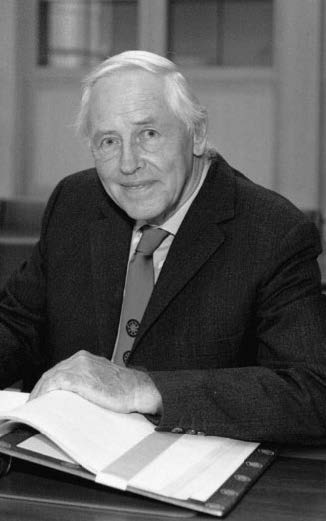
Colin Austin
He named capacitation, laid the foundations of the modern study of fertilisation, and gave Robert Edwards a home at Cambridge.
Colin Austin, known all his life as Bunny, was born in Sydney in 1914. His father was a British Army officer, and his early years were spent in India and England before the family settled in Australia when he was fifteen. He qualified in veterinary science at the University of Sydney in 1936, found practice unappealing, and turned to research, joining the Division of Animal Health of Australia's Council for Scientific and Industrial Research in 1940.
With A. W. H. Braden he began a remarkable run of work on fertilisation in rats, rabbits and mice. In 1951 he reviewed the claims for in vitro fertilisation of mammalian eggs and found the evidence inconclusive. That same year he and M. C. Chang independently showed that sperm cannot fertilise until they have spent time in the female tract. In a letter to Nature in 1952 Austin gave the process its name: capacitation.
Ryuzo Yanagimachi later called him the founder of the modern study of mammalian fertilisation, crediting him with the first description of the acrosome reaction in mammalian sperm, the discovery of the zona reaction, and the first detailed account of normal and abnormal fertilisation. In 1961 he published The Mammalian Egg, and set out five tests that any claim of fertilisation in a dish would have to pass: the sperm must be capacitated; the eggs must not be aged; there must be clear evidence that a sperm had entered the egg; development without a sperm must be ruled out; and, in the end, young must be born that were genetically related to the embryos transferred.
After posts at the National Institute for Medical Research in London, at Woods Hole and at Tulane, he was appointed in 1967 to the new Charles Darwin Chair of Animal Embryology at Cambridge. There he gave Robert Edwards a home in his department while Edwards and Patrick Steptoe pursued human IVF against strong opposition. Edwards remembered him as a clear-thinking supporter, prepared to defend the work publicly when few others would. His first graduate student, Barry Bavister, made the culture fluid used in Edwards's first fertilisations of human eggs.
With Roger Short he edited the much-loved Reproduction in Mammals series for Cambridge University Press. He retired in 1981 to Buderim, in Queensland, and finished its second edition there.
the evidence so far put forward for the fertilization in vitro of mammalian eggs is inconclusive.Colin Austin, Australian Journal of Scientific Research 1951
Naming capacitation, founding the modern study of mammalian fertilisation, and standing by Robert Edwards at Cambridge.
Life and work
- University of Sydney: BVSc 1936, BSc 1938, MSc 1940, DSc 1954
- CSIR (later CSIRO) Division of Animal Health, 1940 to 1954
- National Institute for Medical Research, Mill Hill, London, from 1954
- Marine Biological Laboratory, Woods Hole, and Tulane University, 1960s
- Charles Darwin Professor of Animal Embryology, University of Cambridge, 1967 to 1981
- Fellow of the Australian Academy of Science, 1987
Key papers
- Austin CR. Observations on the penetration of the sperm into the mammalian egg. Australian Journal of Scientific Research B 1951;4:581 to 596. Read
- Austin CR. The "capacitation" of the mammalian sperm. Nature 1952;170:326. ReadThe letter that named capacitation.
- Austin CR. Fertilization of mammalian eggs in vitro. International Review of Cytology 1961;12:337 to 359. ReadWhat would be needed to prove fertilisation in a dish.
- Austin CR. The Mammalian Egg. Oxford: Blackwell Scientific, 1961.
- Austin CR. Ultrastructure of Fertilization. New York: Holt, Rinehart and Winston, 1968.
- Austin CR, Short RV, editors. Reproduction in Mammals. Cambridge University Press, 1972 to 1980; second edition 1982 to 1986.
See also Robert Edwards and the Pioneers wing.
About the sources
- Short RV. Colin Russell Austin 1914 to 2004. Historical Records of Australian Science 2014;25:264 to 272. doi.org/10.1071/HR14024. Birthplace, posts, and Edwards's tribute. The memoir's summary says "English by birth"; its main text says he was born in Sydney, to an English family.
- Encyclopedia of Australian Science: eoas.info.
- Churchill Archives Centre, papers of Robert Edwards (EDWS 8/3): Barry Bavister began as Austin's graduate student.
- Who Was Who: date of death.
- The 1961 review is dated 1961 in the memoir and 1962 in the publisher's index. Austin did not supervise Robert Edwards, whose doctorate was from Edinburgh.
- Johnson MH. A short history of in vitro fertilization (IVF). International Journal of Developmental Biology 2019;63:83 to 92. doi.org/10.1387/ijdb.180364mj. Summarises the five tests of 1961.
The IVF Museum · Pioneers · Colin Austin
Compiled with AI-assisted research and checked against the original sources. Undergoing peer review. Corrections are warmly welcomed.

