Fourteen documents, from 1969 to 2015, that tell the story of how IVF began.
I
How the story unfolded
The story of IVF is often told as a single night in Oldham in July 1978. In fact it unfolded over many years, paper by paper and discovery by discovery. These are the documents that tell it.
This room begins in February 1969, when human eggs were first fertilised in a dish in Cambridge, and ends in 2015, when the Oldham notebooks were finally published. Between them come the birth of Louise Brown, the birth of Durga in Calcutta, the first pregnancies from frozen embryos and frozen eggs, the first tests of embryos to protect a family from inherited disease, and ICSI.
Each object opens into its own exhibit, with the story behind it. The animal research that came first is in The Animal Work.
Two people have their own records at the end of the room: Jean Purdy, who was there from the very beginning, and Subhas Mukherjee, whose work in Calcutta waited years to be recognised.
II
The catalogue
Fourteen objects, 1969 to 2015, in order of publication.
FP·011969
Early Stages of Fertilization in vitro of Human Oocytes Matured in vitro
Nature 1969;221(5181):632–635. Received 13 December 1968; issue of 15 February 1969. PMID 4886881. DOI 10.1038/221632a0.
A newly fertilised human egg, with the two pronuclei that show fertilisation has taken place. Shown for illustration; not from the 1969 paper.Newly fertilised human egg. Alan Handyside. CC0. Source: Wellcome Collection.
What it reportsThe publisher's summary, in full: “Human oocytes have been matured and fertilized by spermatozoa in vitro. There may be certain clinical and scientific uses for human eggs fertilized by this procedure.” The eggs were matured in culture, not collected ripe. The title and summary report the early stages of fertilisation only; they mention no cleavage to a transferable embryo and no pregnancy. First generally accepted
The first generally accepted account of human fertilisation in vitro, not the first claim. Rock and Menkin had claimed it in 1944 [AW·03], and others after them. None of those claims met the criteria Austin set out in 1961 for accepting that a mammalian egg had been fertilised in vitro. This paper is the first that the field accepted.
It was challenged in print three weeks later. A letter headed “Did Fertilization Occur?” appeared in Nature on 8 March 1969 (221:981, DOI 10.1038/221981b0), signed Rothschild from 11 Herschel Road, Cambridge. Edwards, Bavister and Steptoe replied on the same page under the same title (221:981–982, DOI 10.1038/221981c0). Even the accepted demonstration was argued over at the time.
The partnership is visible in the affiliations: Edwards and Bavister at the Physiological Laboratory in Cambridge, Steptoe at Oldham General Hospital. Bavister was a graduate student, and the culture conditions he had worked out for hamster eggs are the subject of [AW·12].
Comes fromAW·02 Pincus and Enzmann, the egg that matures by itself · AW·05 capacitation · AW·08 hamster IVF · AW·12 Bavister's medium
Provenance of this recordREGISTRY and PUBLISHER SUMMARY. Citation, dates and affiliations from PubMed, Crossref and nature.com, read 6 October 2026. The summary is quoted from nature.com. The full text was not re-read for this rebuild, so this label gives no figures from the body of the paper. Rothschild is identified by surname and address only, as the page prints them.
FP·021970
Laparoscopic Recovery of Preovulatory Human Oocytes after Priming of Ovaries with Gonadotrophins
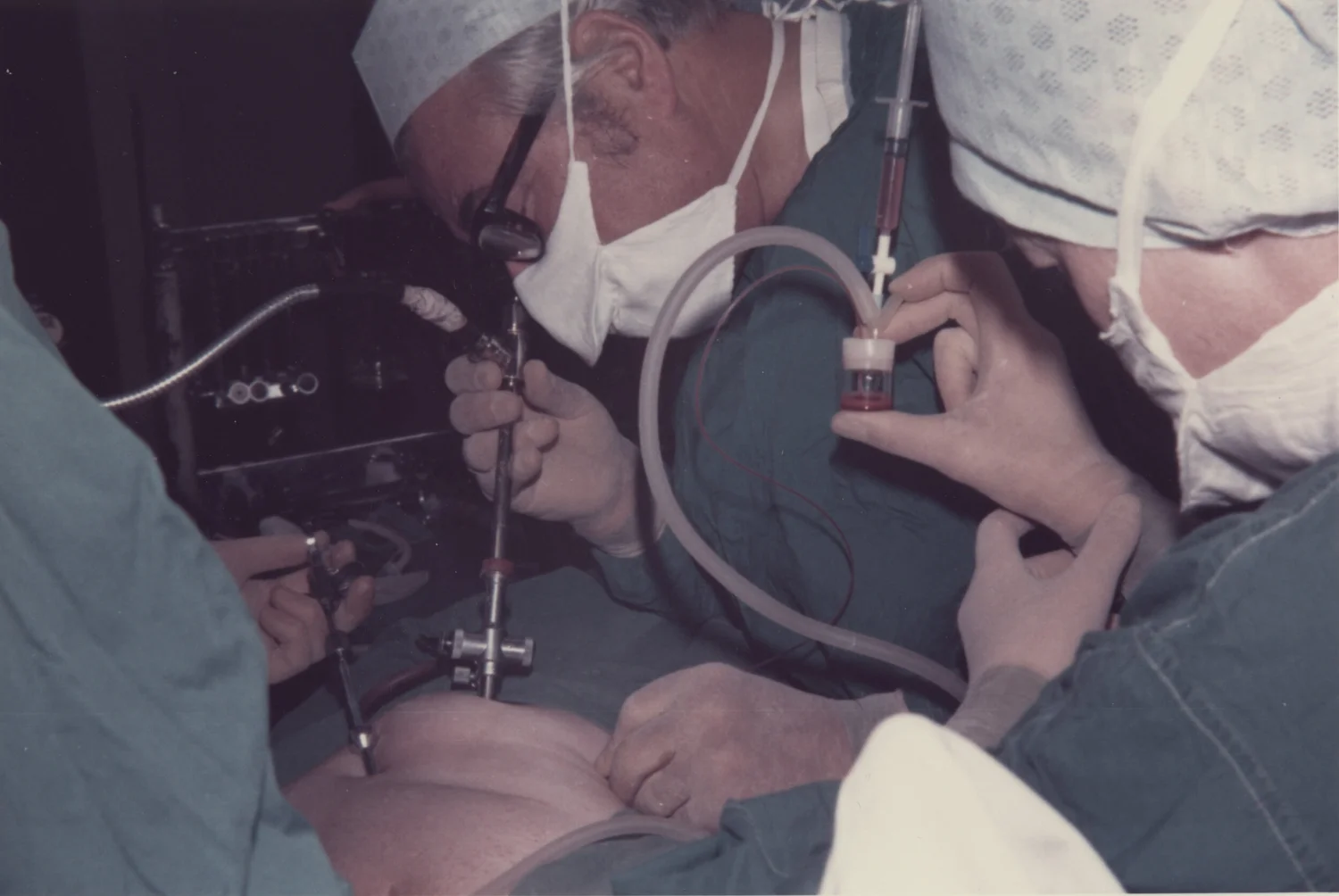
Patrick Steptoe performing a laparoscopic procedure during the clinical research at Oldham, c.1968 to 1978.Churchill Archives Centre, Cambridge. The Papers of Robert Edwards, EDWS 18/1/4.
What it reportsAs its title states: eggs collected by laparoscopy, shortly before they would have been ovulated, from ovaries first stimulated with gonadotrophins. No abstract is indexed, and we have not read the text.
The instrument half of the partnership enters the record. FP·01 used eggs matured in a dish. This paper is about collecting eggs that had matured in the body, using the laparoscope, Steptoe's instrument.
Two words in the title are worth keeping. “Preovulatory”: the eggs are taken at the right moment, not rescued from an unripe follicle. And “priming”: the ovaries were stimulated with hormones. Later accounts often forget that the Oldham programme began with stimulated cycles. The series reported in 1980 used natural cycles instead; see FP·06.
Provenance of this recordREGISTRY ONLY. Citation from PubMed and Crossref, read 6 October 2026. The Lancet returned an access error, and no abstract exists in PubMed or Europe PMC. This label rests on the title.
FP·031970
Fertilization and Cleavage in vitro of Preovulator Human Oocytes
Nature 1970;227(5265):1307–1309. Received 25 August 1970; issue of 26 September 1970. PMID 4916973. DOI 10.1038/2271307a0.
What it reportsThe publisher's summary, in full: “Human oocytes have been taken from the mother before ovulation, fertilized in vitro and grown in vitro to the eight- or sixteen-celled stage in various media.” The summary mentions no embryo transfer and no pregnancy.
The step from fertilisation to an embryo. FP·01 stopped at the earliest signs of fertilisation. Here the embryos divide, to eight and sixteen cells, which is the stage at which an embryo could be put back.
Jean Purdy is a named author. She is third of three. Keep that in mind at FP·04, where she is not named at all. Her record is in section IV.
“Preovulator” is not our misprint. It is how the title appears on the publisher's page, in PubMed and in Crossref.
Comes fromAW·07 Chang 1959, the first unequivocal mammalian IVF
Provenance of this recordREGISTRY and PUBLISHER SUMMARY, read 6 October 2026 on nature.com, PubMed and Crossref. Full text not re-read for this rebuild.
The Lancet 1978;2(8085):366. Issue of 12 August 1978. One page, classed by PubMed as a letter. PMID 79723. DOI 10.1016/S0140-6736(78)92957-4.
Robert Edwards, Patrick Steptoe, Lesley Brown holding Louise Brown, and Jean Purdy, at Louise Brown's first birthday party, July 1979.Churchill Archives Centre, Cambridge. The Papers of Robert Edwards, EDWS 18/9/1/4.
What it reportsAs its title states: a birth after a human embryo was reimplanted. We have not read the letter. That this is the birth of Louise Brown, on 25 July 1978 at Oldham and District General Hospital, is carried from the museum's registry. First live birth
One page, two authors. The most famous document in this collection is a letter of a single page, published eighteen days after the birth. The full account of the method waited two years, for FP·06.
Jean Purdy is not an author. She is named on FP·03 before it and on FP·06 after it. We do not know why she is missing here, and we do not guess. The fact is recorded because the omission became a pattern; see section IV.
The word “reimplantation” has a history. Two years earlier the same authors had reported an embryo returned to the uterus that implanted in the fallopian tube instead: Steptoe and Edwards, “Reimplantation of a human embryo with subsequent tubal pregnancy,” The Lancet 1976;1(7965):880–882, 24 April 1976, PMID 58146. In the words of its abstract, “The ectopic embryo was removed at 13 weeks gestation.”
Comes fromAW·01 Heape 1890, the first embryo transfer · AW·03 Rock and Menkin, the human claim made too early
Provenance of this recordREGISTRY. Citation from PubMed and Crossref, read 6 October 2026; the 1976 abstract quoted from PubMed. The Lancet returned an access error, so the text of the 1978 letter was not re-read for this rebuild. The date and place of birth are carried from the museum's claim registry.
FP·051978
The Feasibility of Long-Term Cryogenic Freezing of Viable Human Embryos: A Brief Pilot Study Report
Subhas Mukherjee · Sunit Mukherjee · S. K. Bhattacharya
Indian Journal of Cryogenics 1978;3:80, as cited by Anand Kumar (FP·13), who prints the authors as “Mukerji, S., Mukherjee, S. and Bhattacharya, S. K.” Not indexed in PubMed or Europe PMC. The title is known from a 2024 secondary source; Anand Kumar gives none. Some later sources date the note to 1979.
What it reportsAs quoted by Anand Kumar: eggs collected by surgery were fertilised and cleaved in vitro, frozen slowly after stepwise treatment with dimethyl sulphoxide, and “One such frozen embryo was subsequently thawed slowly and when transferred into the uterus of the woman apparently resulted in the production of a clinically normal female baby after normal period of gestation.” Reported, not verifiedPriority contested
The record of the second IVF birth, if births recognised only in retrospect are counted. A girl, given the name Durga and now known as Kanupriya Agarwal, was born in Calcutta on 3 October 1978: seventy days after Louise Brown. Anand Kumar records that Calcutta Doordarshan “flashed the news” of the birth. A booklet from ICMR-NIRRCH, the Indian Council of Medical Research institute that now holds his papers, adds that she was delivered by caesarean section and that the Amrita Bazar Patrika reported the birth on 6 October.
A second document survives only inside another. On 19 October 1978, at the request of the Government of West Bengal, the three men submitted a signed report titled “Transfer of in vitro fertilized frozen-thawed human embryo.” This museum has not seen the report itself. Its text is known to us through Anand Kumar's quotations of it in 1997: embryos equilibrated with 1.5M dimethyl sulphoxide, frozen in ampoules, and “stored in cryogen for about 53 days.”
What this museum will and will not say. We say that the birth happened, that the method differed from Oldham's, and that it involved an embryo reported as frozen and thawed. We do not say that this was the first birth from a frozen embryo. The freezing is documented by one short note in a journal not indexed in PubMed or Europe PMC, a report known only through quotation, and notebooks reviewed by Anand Kumar in 1997. That is enough to state the claim. It is not the standard FP·07 to FP·09 had to meet, and the badge says so.
Provenance of this recordSECONDARY, QUOTED. Read 6 October 2026: Anand Kumar's 1997 paper (FP·13), from the scan on currentscience.ac.in, read by OCR; and the ICMR-NIRRCH commemorative booklet (Srabani Mukherjee and Rajvi H. Mehta, 2020). The 1978 note and the 19 October report have not been seen. Neither source is a birth record.
FP·061980
Establishing Full-Term Human Pregnancies Using Cleaving Embryos Grown in vitro
What it reportsFrom the abstract: eggs were collected at laparoscopy “soon after the beginning of the mid-cycle surge of luteinizing hormone (LH) during the natural cycle,” the surge being found by assaying urine every three hours. “The surge of LH was identified in 68 patients”; “Fertilization and cleavage occurred in 34 instances, and 32 embryos were put into the mother via the cervical canal. Four patients became pregnant,” each of them when the embryos were transferred in the late evening.
The full account, two years after the letter. Twenty pages, reporting a series rather than a single case. This is where the natural cycle, the three-hourly urine assays and the late-evening transfers are set down.
Read the numbers in their own terms. The abstract counts 68 patients with a detected surge, 34 instances of fertilisation and cleavage, 32 embryos transferred and four pregnancies. It does not say, in the abstract, how many of the four pregnancies went to term, and we do not supply the number from elsewhere. The notebooks published in 2015 (FP·14) count the whole programme differently, from 1969 to 1978, and record two live births.
Jean Purdy is a named author.
Comes fromAW·04 the first calf from a transferred embryo · AW·06 Whitten, culture and pH · AW·09 Brinster's culture system
Provenance of this recordREGISTRY and ABSTRACT. Abstract quoted from PubMed and Europe PMC, read 6 October 2026. The publisher returned an access error; full text not read.
FP·071983
Human Pregnancy following Cryopreservation, Thawing and Transfer of an Eight-Cell Embryo
Nature 1983;305(5936):707–709. Received 25 May 1983; issue of 20 October 1983. PMID 6633637. DOI 10.1038/305707a0. Monash University, Queen Victoria Medical Centre, Melbourne.
An eight-cell human embryo from IVF, the stage at which the embryo in this paper was frozen. Shown for illustration.Human embryo from IVF. K. Hardy. CC BY 4.0. Source: Wellcome Collection.
What it reportsFrom the abstract: freezing methods giving “a high survival rate of four- and eight-cell human embryos and the establishment of a pregnancy following the freezing and storage of an eight-cell embryo for 4 months in liquid nitrogen.” Then: “The pregnancy terminated at 24 weeks' gestation due to development of a septic Streptomyces [sic] agalactiae chorion amnionitis after premature membrane rupture.” First pregnancy
A pregnancy, not a birth, and the paper says so in its own abstract. It is the first pregnancy from a frozen human embryo reported in an internationally indexed journal, and the pregnancy was lost.
The organism is printed as Streptomyces on the publisher's page and in PubMed. It is almost certainly Streptococcus agalactiae, group B streptococcus. We quote it as printed and mark it.
A birth followed five months later in the same hospital: Zoe Leyland, born 28 March 1984 (registry), described by Monash at the time as the first authenticated birth from a frozen embryo.
Comes fromAW·13 the two-factor hypothesis of freezing injury · AW·14 the first mice from frozen embryos
Provenance of this recordDIRECT for the abstract, read on nature.com and PubMed, 6 October 2026. Full text not read. Zoe Leyland's birth date is carried from the museum's claim registry and was not re-checked for this rebuild.
FP·081984
Two Pregnancies following Transfer of Intact Frozen-Thawed Embryos
G. H. Zeilmaker · A. T. Alberda · I. van Gent · C. M. Rijkmans · A. C. Drogendijk
What it reportsTwo pregnancies after the transfer of frozen and thawed embryos, described in the title as intact. That is what the title says, and it is all we can say: no abstract is indexed, and we could not read the paper. Pregnancies
An object displayed on its title alone, and labelled that way. The Timeline wing called this the first births from frozen embryos. The title reports pregnancies, and without the text we cannot say more. We have corrected the Timeline's wording to match.
Comes fromAW·15 Wilmut's freezing variables · AW·16 Frostie, the first calf from a frozen embryo
Provenance of this recordREGISTRY ONLY. Citation from PubMed and Europe PMC, read 6 October 2026. No abstract in either. The publisher returned an access error.
FP·091985
Birth after Transfer of Cryopreserved Embryos
B. G. Downing · L. R. Mohr · A. O. Trounson · L. E. Freemann · C. Wood
What it reportsThe abstract, first sentence: “A normal baby girl was delivered after the successful transfer of two thawed embryos which had been frozen for eight weeks.” Live birth
Included so the frozen-embryo question can be settled from a document rather than asserted. FP·07 and FP·08 report pregnancies. This abstract reports a delivery.
It shares two authors with FP·07, and it is natural to assume the baby is Zoe Leyland. The abstract does not say so. It gives no name, date or place of birth, and we have not read the text, so we do not make the link.
The abstract also states why freezing mattered: it “may improve the chances of conception”, “reduce the risks of multiple pregnancies” and offer conception to women whose ovarian function is threatened by disease.
Provenance of this recordDIRECT for the abstract, read in PubMed and Europe PMC, 6 October 2026. Full text not read.
What it reportsFrom the abstract: “The first successful attempt at deep freezing and thawing of the human oocyte is reported. A twin pregnancy was achieved after insemination and replacement in utero.” Dimethyl sulphoxide was added in one step, with slow cooling and storage in liquid nitrogen. “80% of forty oocytes showed morphological survival after freezing and thawing. Thirty of these were inseminated; 83% retained their capacity to be fertilised, and 60% proceeded to cleavage division.” First pregnancy
The first reported pregnancy from frozen eggs. A pregnancy, not a birth. The paper has a single author, and makes its own claim: “The first successful attempt at deep freezing and thawing of the human oocyte”.
We quote the percentages exactly as printed. The abstract does not make clear whether the 60% is of the thirty inseminated eggs or of those that fertilised, so we do not convert it into numbers of eggs.
Provenance of this recordDIRECT for the abstract, read in PubMed, 6 October 2026. The Lancet returned an access error. The author is indexed by initial only, and we print no more than that.
FP·111990
Pregnancies from Biopsied Human Preimplantation Embryos Sexed by Y-Specific DNA Amplification
A. H. Handyside · E. H. Kontogianni · K. Hardy · R. M. Winston
Nature 1990;344(6268):768–770. Issue of 19 April 1990. PMID 2330030. DOI 10.1038/344768a0.
Micromanipulation equipment used for embryo biopsy.Alan Handyside. CC0. Source: Wellcome Collection.
What it reportsFrom the abstract: “the first established pregnancies using this procedure, in two couples known to be at risk of transmitting adrenoleukodystrophy and X-linked mental retardation.” One cell was removed from each embryo at the six- to eight-cell stage, and the embryo's sex was found by amplifying a Y-chromosome sequence. “Two female embryos were transferred”; “Both women are confirmed as carrying normal female twins.” First pregnancy
The beginning of clinical preimplantation genetic diagnosis. The purpose was to avoid serious X-linked conditions, which mostly affect boys, by transferring only female embryos. This is sexing for a medical reason. It is not PGT-A, the later screening of embryos for chromosome number.
Not the first embryo biopsy. Gardner and Edwards had sexed rabbit blastocysts in 1968, and Handyside's group had biopsied human embryos in 1989. What this paper adds is the first pregnancies. It reports pregnancies, not births.
“X-linked mental retardation” is the term the paper used in 1990. Today the condition would be called X-linked intellectual disability.
Provenance of this recordDIRECT for the abstract, read in PubMed and Europe PMC, 6 October 2026. Authors as indexed in PubMed. The 1968 and 1989 precedents are carried from the museum's claim registry.
FP·121992
Pregnancies after Intracytoplasmic Injection of Single Spermatozoon into an Oocyte
G. Palermo · H. Joris · P. Devroey · A. C. Van Steirteghem
ICSI: a human egg held on a holding pipette while a single sperm is injected. Shown for illustration.Eugene Ermolovich (CRMI), CC BY-SA 3.0, via Wikimedia Commons.
What it reportsFrom the abstract: couples whose infertility was due to severely impaired sperm, and in whom IVF and subzonal insemination (sperm placed beneath the egg's outer coat) had failed. “Direct injection of a single spermatozoon into the ooplasm was done in 47 metaphase-II oocytes: 38 oocytes remained intact after injection, 31 became fertilised, and 15 embryos were replaced in utero. Four pregnancies occurred after eight treatment cycles”: two singletons, one twin pregnancy and one preclinical loss. “Two healthy boys have been delivered from the singleton pregnancies and a healthy boy and girl from the twin pregnancy.” First live births
The title says pregnancies. The abstract reports four babies. By publication, three of the four pregnancies had already ended in births. This museum's Timeline described this paper as “pregnancies, not births”, which was wrong, and we have corrected it.
ICSI was developed for male-factor infertility. It is now used far more widely than that, including in many cycles where sperm quality is normal.
Provenance of this recordDIRECT for the abstract, read in PubMed, 6 October 2026. The Lancet returned an access error. Authors as indexed in PubMed.
FP·131997
Architect of India's First Test Tube Baby: Dr Subhas Mukerji (16 January 1931 to 19 July 1981)
Current Science 1997;72(7):526–531. Historical notes. Issue of 10 April 1997. Not indexed in PubMed. Open scan at currentscience.ac.in.
What it reportsA historical note, published nineteen years after the event, making the case for Mukherjee's work from his papers and correspondence. It quotes the 19 October 1978 report (FP·05), quotes the 1978 note, sets out the inquiry that rejected the work, and calls Durga “India's first and the world's second test tube baby”.
Most of what is known about the inside of Mukherjee's work passes through this paper. It is our only source for the text of the 19 October 1978 report, and it preceded ICMR's formal recognition of the work in 2002.
Three details to read carefully. The title spells his name Mukerji; this museum uses Mukherjee, as its other wings do, and Mukhopadhyay is also found. The title gives his death as 19 July 1981; this museum gives 19 June and explains why on Pioneers. And the paper dates the inquiry committee's meeting to 18 November 1978, where the ICMR-NIRRCH booklet gives the 17th. Both describe one meeting. We print both dates rather than choose.
The paper also records Mukherjee's transfer order, dated 5 June 1981, and states he died “44 days after” it. That figure is the author's own subtraction from his July date, not a separate witness to it.
Provenance of this recordDIRECT. The six-page scan was read by OCR on 6 October 2026. Quotations were checked by eye against the scan.
FP·142015
The Oldham Notebooks: An Analysis of the Development of IVF 1969–1978
Reproductive BioMedicine and Society Online 2015;1(1), June 2015. Six papers, open access: I. Introduction, materials and methods. Elder & Johnson, 3–8. DOI 10.1016/j.rbms.2015.04.001. II. The treatment cycles and their outcomes. Elder & Johnson, 9–18. DOI 10.1016/j.rbms.2015.04.003. A correction was published in 2018. III. Variations in procedures. Elder & Johnson, 19–33. DOI 10.1016/j.rbms.2015.04.004. IV. Ethical aspects. Johnson & Elder, 34–45. DOI 10.1016/j.rbms.2015.04.002. V. The role of Jean Purdy reassessed. Johnson & Elder, 46–57. DOI 10.1016/j.rbms.2015.04.005. VI. Sources of support and patterns of expenditure. Johnson & Elder, 58–70. DOI 10.1016/j.rbms.2015.04.006.
What it reportsAn analysis of 21 notebooks and 571 loose pages recording cycles “planned, attempted and undertaken between 9 January 1969 and 1 August 1978 by Robert Edwards, Patrick Steptoe and Jean Purdy in Oldham”. From Part II: “a minimum of 282 women were involved in 495 cycles”; “a total of 112 embryo transfers were attempted”; “a maximum of 11 possible biochemical/preclinical pregnancies plus five clinical pregnancies were observed”, “from which two healthy live births resulted.”
The whole programme, not just its successes. FP·04 reports one birth. The notebooks show what it took: at least 282 women, most of whom never became pregnant, over nine years. They are the women this room otherwise leaves out.
Part V is the source of almost everything this museum can say about Jean Purdy with confidence. Its conclusion: “Purdy's role was a highly significant and under-appreciated element in the achievement of IVF in Oldham.” Part VI names two further people the usual story omits, Muriel Harris and Lillian Lincoln Howell.
The six papers do not count identically. Part II records embryos in “at least 167” cycles; Part III describes about 221 embryos in 165 cycles. We note the difference and do not resolve it.
Provenance of this recordDIRECT for the abstracts, read in PubMed, 6 October 2026, with Part V read in full on Europe PMC. The notebooks themselves are in the Edwards papers at the Churchill Archives Centre, Cambridge (EDWS).
III
How the firsts are counted
Who was “first” depends on how you count.
Durga was born in Calcutta seventy days after Louise Brown. If births recognised later are included, she was the second IVF baby in the world; if only births documented internationally at the time are counted, she does not appear. This museum shows both counts side by side.
The early IVF births, and how each is badged
Person
Born
Place
Internationally documented record
Including births recognised in retrospect
Badge
Louise Brown
25 July 1978
Oldham and District General Hospital
1st
1st
First live birth
Durga (Kanupriya Agarwal)
3 October 1978
Calcutta
Not counted
2nd
Priority contested
Alastair MacDonald
14 January 1979
Stobhill Hospital, Glasgow
2nd
3rd
Independently documented
Candice Reed
23 June 1980
Royal Women's Hospital, Melbourne
3rd
4th
Independently documented
Elizabeth Carr
28 December 1981
Norfolk, Virginia
First IVF birth in the United States
First live birth (US)
Frozen embryos and eggs: what each document reports
The birth dates and places in the first table, and rows marked Registry in the second, are carried from this museum's claim registry and were not re-read against a primary source for this rebuild.
IV
Jean Purdy: the record
Jean Marian Purdy, 25 April 1945 to 16 March 1985. A nurse by training, and an embryologist of the Oldham programme by what she did.
Jean Purdy. Undated.Churchill Archives Centre, Cambridge. The Papers of Robert Edwards, EDWS 18/7/8.Bunny Austin, Barbara Rankin, Robert Edwards and Jean Purdy, October 1978. Barbara Rankin holds a cartoon by Alan Handyside about the birth of Louise Brown.Churchill Archives Centre, Cambridge. Barbara Rankin's scrapbooks, BARA 3.
What the documents show
She is an author on the founding papers before and after the birth, FP·03 in 1970 and FP·06 in 1980, and absent from the letter that announced it, FP·04.
The notebooks show her work directly. Johnson and Elder's reading of them (FP·14, Part V) found that she recorded and organised most of the data systematically, and probably spent longer working in Oldham than Edwards did. Their conclusion is that her role was “a highly significant and under-appreciated element in the achievement of IVF in Oldham.”
Edwards asked for her to be named. From July 1980 he pressed for plaques that would name her, and in January 1981 wrote that he regarded her “as an equal contributor to Patrick Steptoe and myself”. The plaque went up without her. The full correspondence is set out on Institutions.
Recognition came after her death. A blue plaque naming her was unveiled at Dr Kershaw's on 13 March 2015, and a plaque at the Royal Oldham Hospital on 9 March 2022 honours her and Sister Muriel Harris.
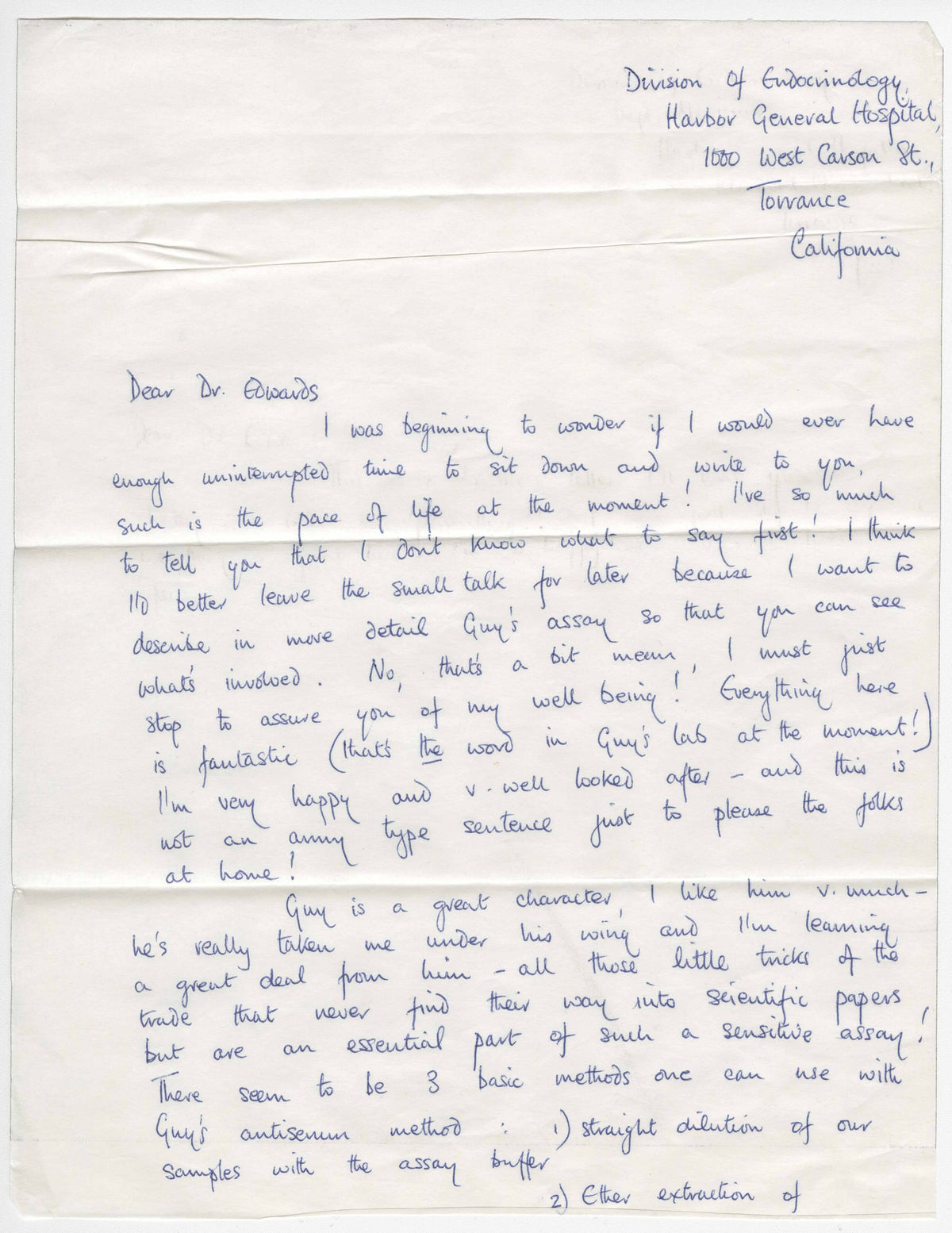
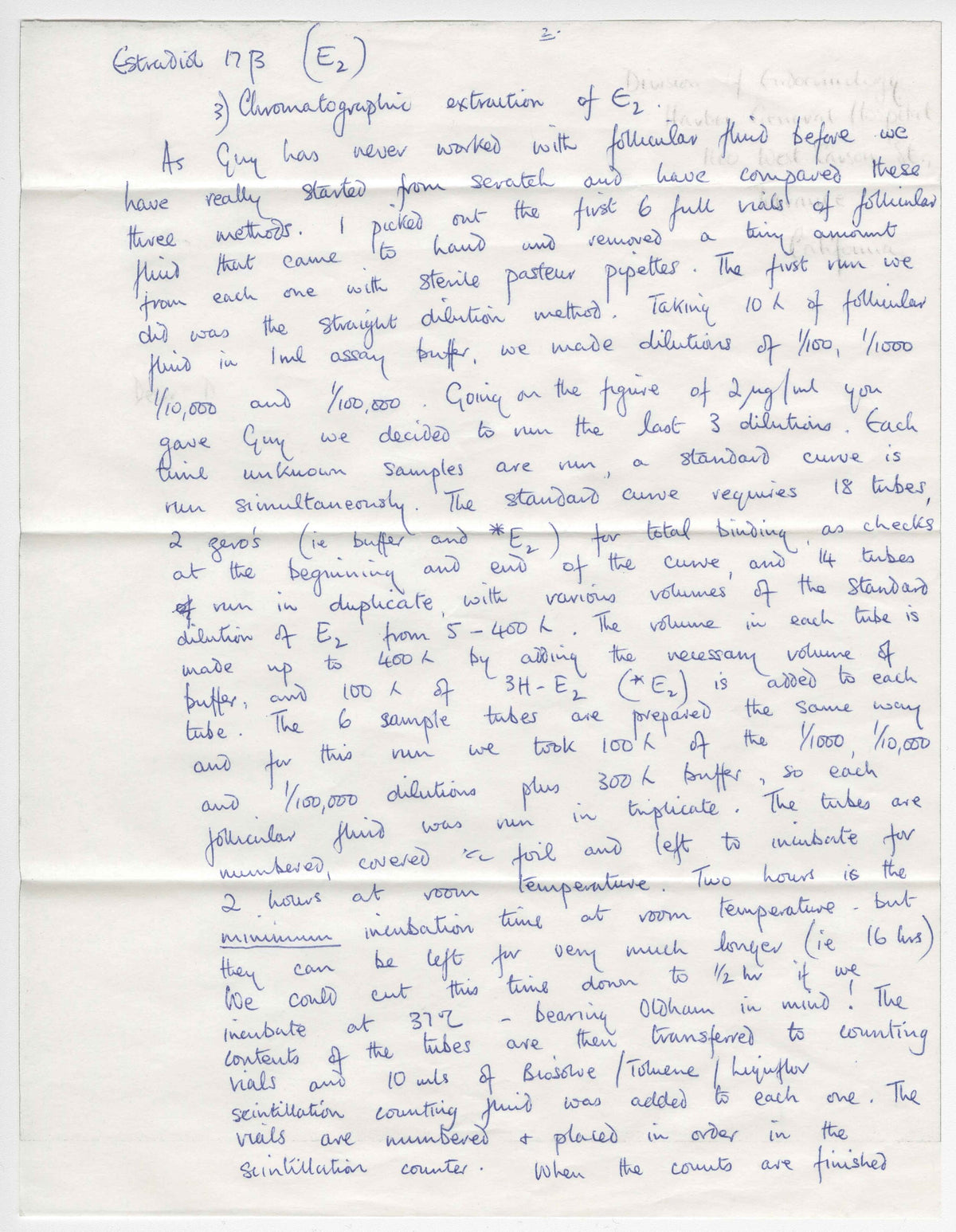
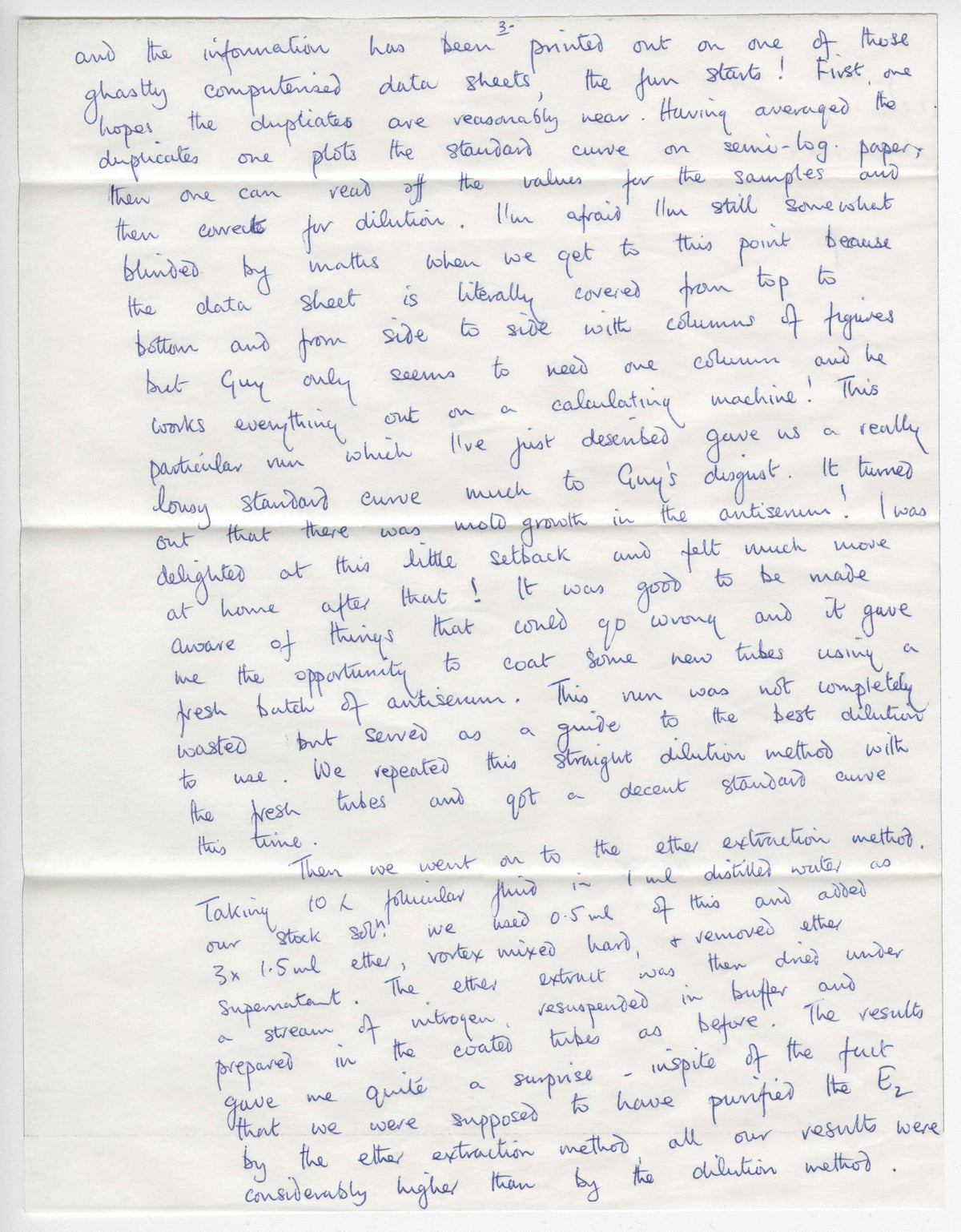
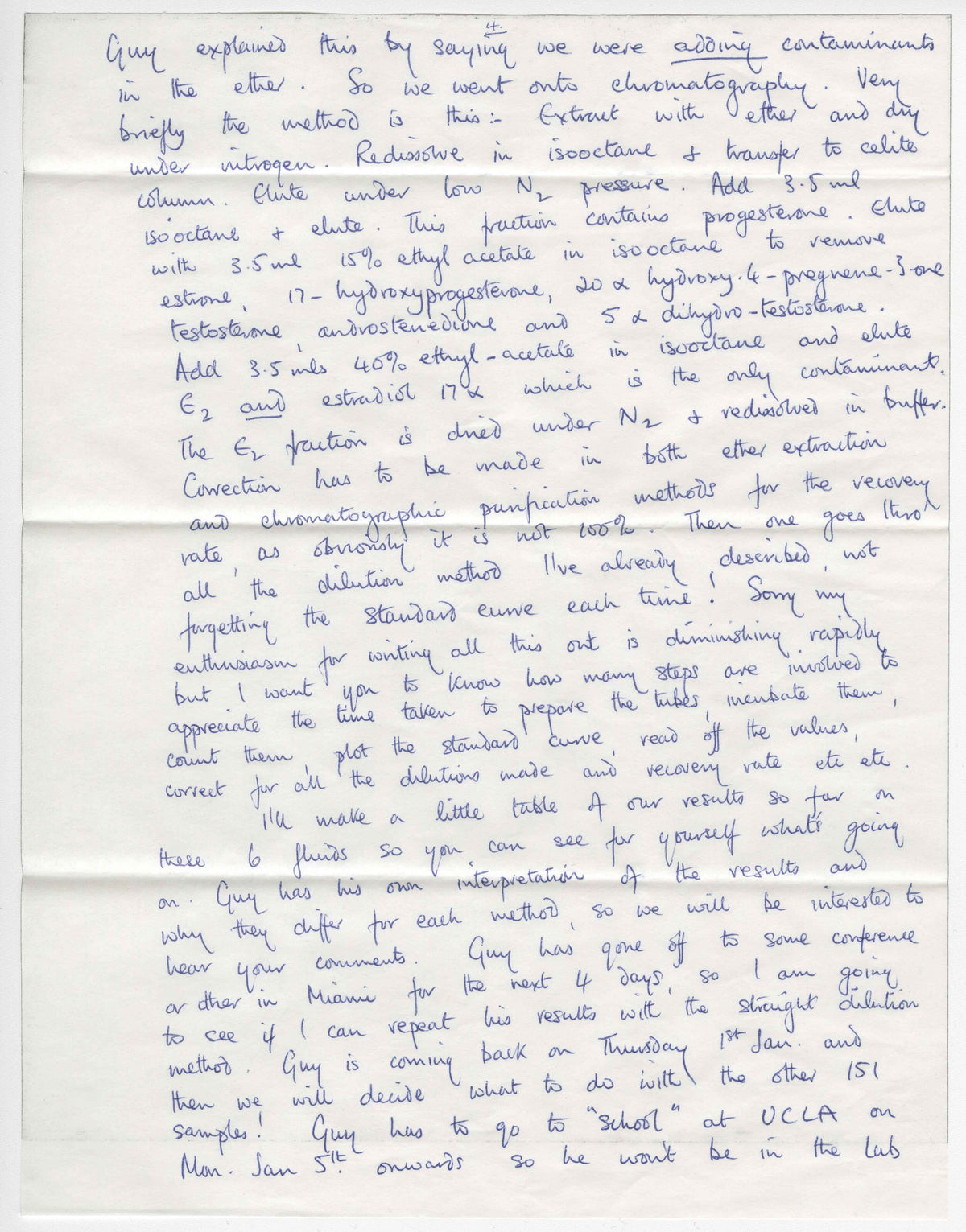
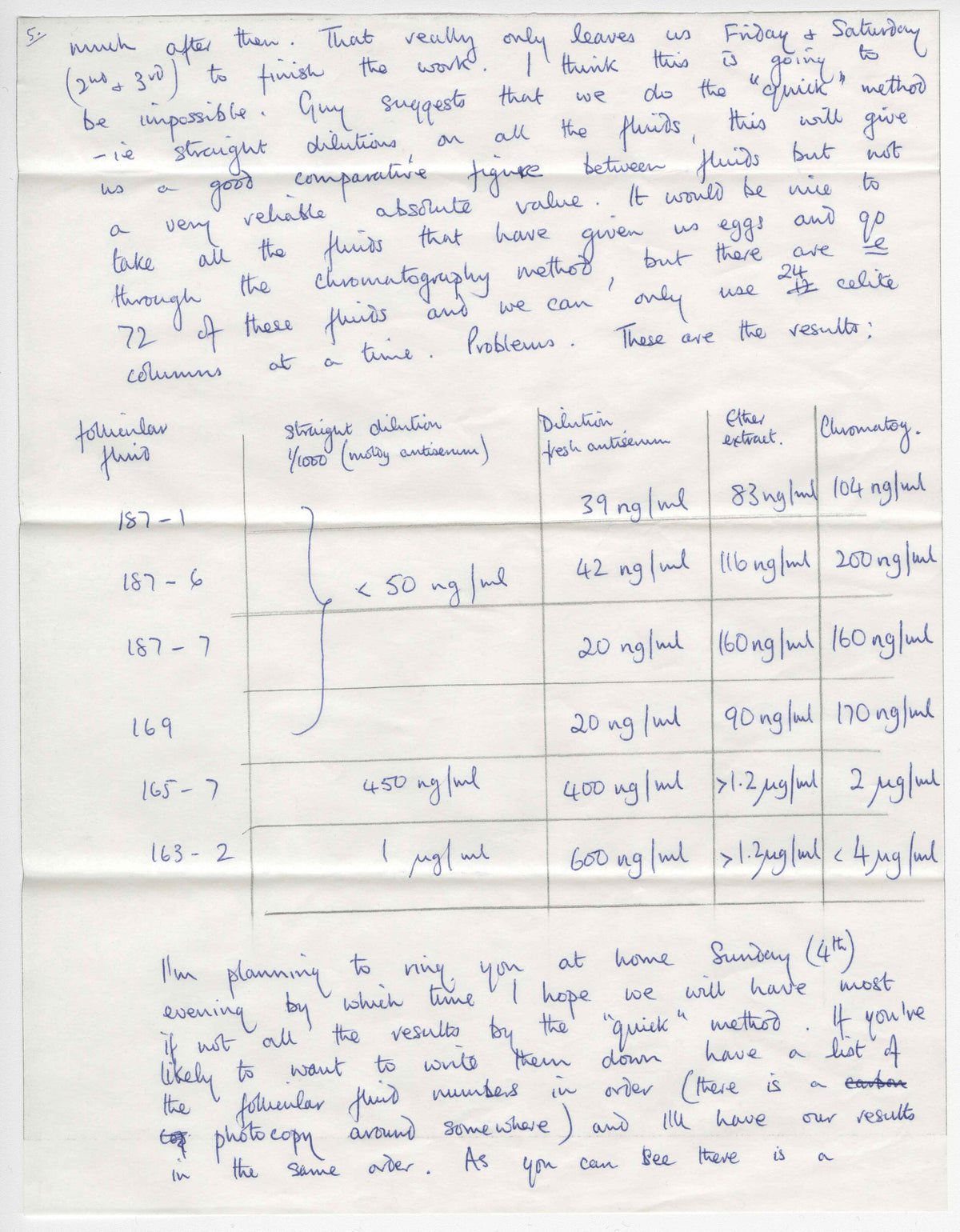
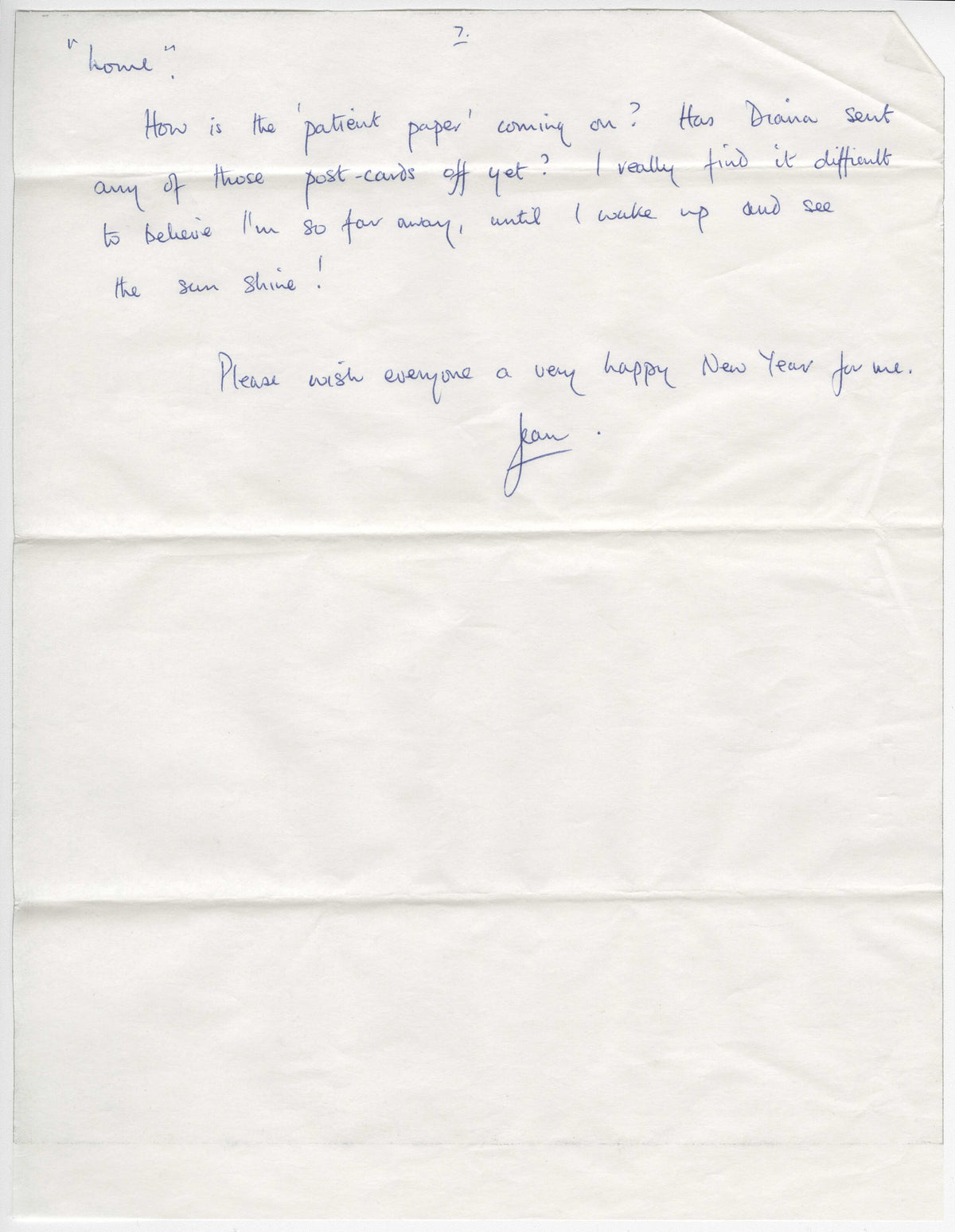
Jean Purdy's letter to Robert Edwards from California, December 1969, describing her research in detail. Seven pages; select a page to enlarge it.Churchill Archives Centre, Cambridge. The Papers of Robert Edwards, EDWS 1/7/9.Robert Edwards to the Hospital Secretary, 7 July 1980, asking for two plaques that would name Jean Purdy among others.Churchill Archives Centre, Cambridge. The Papers of Robert Edwards, EDWS 1/1/1/52.
What remains uncertain
That she collected eggs. She was not involved in laparoscopy. A widely reproduced photograph appears to show her doing so. The historians who found it describe it as posed. If this museum ever displays it, it will be labelled as posed.
That she held an embryology qualification. She was a State Registered Nurse. “Embryologist” describes the work, not a credential.
Her full entry, with life dates and their authorities, is on Pioneers.
V
Subhas Mukherjee: the record
Subhas Mukherjee, 16 January 1931 to 19 June 1981. A reproductive physiologist in Calcutta, who led the team behind the birth of Durga.
What survives
One short published note, FP·05, in a journal not indexed in PubMed or Europe PMC. One report to his government, dated 19 October 1978, known only through its quotation in 1997. His notebooks and correspondence, kept for decades by his colleague Sunit Mukherjee and now held by ICMR-NIRRCH in Mumbai, with no published catalogue. And his Edinburgh doctoral thesis of 1963, a document in his own hand that can still be read.
What was done to the work
A committee convened in West Bengal met on 17 or 18 November 1978; the two sources disagree on the day. It contained no specialist in reproductive medicine and found the work “bogus”. He was refused permission to travel to present it, and transferred to a post in electrophysiology. He died by suicide on 19 June 1981.
In 1997 T. C. Anand Kumar went through his papers and argued for the claim (FP·13). ICMR formally recognised the work in 2002.
His names
He appears as Mukherjee, Mukerji and Mukhopadhyay. Anand Kumar's paper uses Mukerji. This museum uses Mukherjee throughout and records the others so that searches find him.
The death date is contested, and this museum's reasons for printing 19 June are set out on Pioneers. The places, and the institutions that obstructed him, are on Institutions.
VI
Sources and notes
This room was rebuilt on 6 October 2026, after the original page could not be recovered. Every label was checked again from the start, against the record as it can be read today.
Read the notes on sources
Citations were taken from PubMed, Europe PMC and Crossref, and summaries from the publishers' own pages where they could be opened. Anand Kumar's paper was read from the journal's scan. Nothing was written from memory; facts carried from the museum's other wings are listed below. Each provenance line says how far our record of that object goes.
What we could not read.The Lancet, the British Journal of Obstetrics and Gynaecology and Fertility and Sterility returned access errors. For FP·02, FP·04, FP·06, FP·08, FP·10 and FP·12 we rely on titles and abstracts. The full texts of the four Nature papers were not read for this rebuild either; for FP·07 and FP·11 we rely on the abstracts. Mukherjee's 1978 note and his 19 October report have not been seen by anyone at this museum.
What this rebuild corrected.
ICSI, 1992. The Timeline called Palermo's paper “pregnancies, not births”. Its abstract reports four babies delivered.
Frozen embryos, 1984. The Timeline called Zeilmaker's paper the first births from frozen embryos. Its title reports two pregnancies, and the text could not be read.
The Oldham Notebooks are six papers, not five. Purdy's role is Part V.
Anand Kumar's paper spells the name Mukerji in its title, and dates the committee to 18 November, where ICMR-NIRRCH gives the 17th; we print both.
Carried from the registry and not re-checked here: the birth dates and places of Louise Brown, Alastair MacDonald, Candice Reed, Elizabeth Carr and Zoe Leyland; the 1968 and 1989 biopsy precedents; Austin's 1961 criteria (FP·01); and the biographical details of Jean Purdy and Subhas Mukherjee, which match their entries on Pioneers and Institutions. They are consistent with the other wings and are marked where they appear.
Search our store
Back to top
Spend $250 to get free shippingSpend $250 more to get free shippingCongratulations! You get free shipping.