Timeline
Timeline
Timeline
Eighty moments, from 1890 to 2022, that take IVF from a rabbit experiment to a treatment used around the world: the science, the births and the laws, on one line.
Following the story
Most histories of IVF keep the laboratory and the law in separate books. Here they share one line, and you can watch them run side by side.
Two things are worth watching for. The first is how long the animal work runs before anything human happens: sixty years of it, in Eras I and II. The second is how long the law took to catch up. Louise Brown was born in 1978, and IVF in Britain did not become a licensed activity until 1 August 1991.
Most entries link to an object or a person elsewhere in the museum, so you can step off the timeline into the full story.
18 entries are marked partial. That usually means a month rather than a day, an institutional source rather than a primary one, or a date that is secure while a detail attached to it is not.
The chronology
Before the beginning
1890–1951
Nothing in this era was done with human IVF in mind. An experiment on heredity, a contested claim about rabbits, a wartime egg hunt in Boston, and a calf in Wisconsin.
27 April 1890
The first mammalian embryo transfer
Walter Heape moves two four-cell ova between rabbits — in a laboratory in his own house at Prestwich, Manchester, not at Cambridge. The surgery is performed by Samuel Buckley.
In the collection →14 October 1890
Heape presents the work to the Royal Society
Thirteen days after being notified of his election as Balfour Student — which he was not yet when he did the experiment.
In the collection →1934–1935
Pincus and Enzmann claim rabbit fertilisation in vitro
The claim does not survive its own papers. What survives, and matters, is the finding that an oocyte released from its follicle matures by itself.
In the collection →4 August 1944
Rock and Menkin publish the first claim of human IVF
Three of 138 inseminated eggs cleave. Contested then and now; capacitation was unknown, so it could not have been arranged for.
In the collection →1949
Hammond cultures mouse ova in egg-white saline
The first step away from plasma and embryo extract, toward a medium that could be made reproducibly.
In the collection →2 March 1951
The first calf from a transferred embryo
Published by Willett and colleagues at Wisconsin; the calf itself was born in 1950. Heape's result, carried into a large mammal sixty-one years later.
In the collection →The key
1951–1959
Two men on opposite sides of the world find the same thing within weeks, and neither fights about it. Everything that had been failing now had a reason.
20 October 1951
Chang: sperm need time in the female tract
Nature 168:697. Publication puts him first by four to eight weeks; neither paper's submission date is obtainable.
In the collection →November–December 1951
Austin reports the same requirement, independently
The month is disputed between the indexers and the publisher. His paper also reviews the existing IVF claims and calls the evidence “inconclusive”.
In the collection →23 August 1952
Austin names it: capacitation
The word appears in the title in scare quotes, and the paper opens by crediting Chang's findings alongside his own.
In the collection →1954
The first sperm seen inside an egg fertilised in vitro
Dauzier, Thibault and Wintenberger, using capacitated sperm — the first application of the 1951 discovery to a dish.
In the collection →14 January 1956
Whitten identifies pH as the variable that mattered
Bicarbonate buffering replaces drifting egg-white medium. Every CO₂ incubator in every IVF laboratory descends from this one-page letter.
In the collection →27 September 1958
McLaren and Biggers: mice born after culture outside the body
Eight-cell mouse embryos cultured in Whitten's medium for about a day to blastocyst, transferred to foster mothers, and born as normal genetically marked young. No fertilisation happened in glass — what this proves is the other half of IVF, that culture outside a body need not cost an embryo its future. It precedes Chang's rabbit IVF by a year, and it is the paper Edwards needed. Added in August 2026 after an external reviewer noticed it was missing.
In the collection →8 August 1959
Chang proves mammalian IVF, by getting living young
Black-rabbit eggs fertilised in vitro, transferred to a white doe, black litter born. He set the evidence standard himself: cytology is not proof.
In the collection →Building the conditions
1960–1968
The unglamorous decade. Media, dishes, species — the work that had to exist before anyone could try it on a human egg.
October 1963
Yanagimachi and Chang fertilise hamster eggs in vitro
The hamster, not the mouse, becomes the immediate donor species to human IVF.
In the collection →October 1963
Brinster's micro-drop under oil
Followed by a four-part dissection of osmolarity, pH, energy source and nitrogen source. The dish is still the standard vessel.
In the collection →1968
Whitten and Biggers: complete development in a chemically defined medium
No serum, no egg white, no fluid of unknown composition. The paper Whittingham cites in the mouse IVF paper of the same year.
In the collection →9 November 1968
Whittingham fertilises mouse eggs in vitro
Received 8 August 1968. Mouse IVF is routinely dated to 1971; it is 1968.
In the collection →The human decade
1969–1978
Ten years from the first documented human fertilisation in a dish to a birth — and, seventy days after that birth, a second one in Calcutta that the field would not accept for nineteen years.
15 February 1969
Edwards, Bavister and Steptoe document human fertilisation in vitro
Early stages of fertilisation only — no cleavage to a transferable embryo, no pregnancy. In a hamster medium.
In the collection →April 1969
Bavister finds hamster fertilisation is steeply pH-dependent
Work done in 1968 by Austin's graduate student, aged twenty-five. It produced the medium that made the human experiment work.
In the collection →1970
Steptoe and Edwards recover oocytes by laparoscopy
The instrument half of the partnership enters the record — with ovaries primed by gonadotrophins, a fact later accounts often mislay.
In the collection →September 1970
Fertilisation and cleavage in vitro
Jean Purdy is a named author. No transfer, no pregnancy.
In the collection →10 September 1971
Mouse embryos survive freezing
Whittingham, alone, in Nature. Survival but no offspring — a paper almost universally omitted from the 1972 story.
In the collection →April 1972
Mazur, Leibo and Chu publish the two-factor hypothesis
The physics of freezing injury — six months before the application, by two of the same three authors.
In the collection →27 October 1972
Live young from frozen mammalian embryos
More than 2,500 embryos frozen, about 1,000 transferred. The ancestor of the frozen embryo transfer cycle.
In the collection →November 1972
Wilmut reaches the same four variables, independently
At Cambridge, while Oak Ridge was doing it too. Who submitted first cannot be established.
In the collection →30 June 1973
Frostie — the first calf from a frozen embryo
Wilmut and Rowson. The first frozen-thawed embryo of any farm species to become a living animal.
In the collection →1976
Lambs from frozen embryos
Willadsen and colleagues confirm it in a third species, and establish that warming rate has a sharp optimum.
In the collection →25 July 1978
Louise Brown is born
At Oldham and District General Hospital, by caesarean. The first human born after in-vitro fertilisation and embryo transfer.
In the collection →12 August 1978
One page in The Lancet
Two authors. Jean Purdy, a named author on the team's substantive papers, is not among them.
In the collection →3 October 1978
Durga is born in Calcutta
Seventy days after Louise Brown, by a different method — and from embryos that had been frozen and thawed.
In the collection →19 October 1978
Mukherjee reports to the Government of West Bengal
The signed report that survives only through its verbatim reproduction nineteen years later.
In the collection →18 November 1978
The committee rejects his claim
Chaired by a professor of radiophysics, with no specialist in reproductive medicine among its members.
In the collection →The world follows, and the law arrives
1979–1991
Nine countries, four committees, two free votes and one Act. This is the era in which societies decided what they were going to allow — and, in Britain, took thirteen years to do it.
14 January 1979
Alastair MacDonald, the second IVF baby and the first boy
Born at Stobhill Hospital, Glasgow, from the Oldham programme. Oldham was a programme, not a single event.
18 June 1979
The 14-day limit is proposed — in the United States
The Ethics Advisory Board of the US Department of Health, Education and Welfare, at 44 FR 35033. Five years before Warnock.
1980
Bourn Hall opens
Founded by Edwards and Steptoe after the NHS declined to support the work. Jean Purdy found the property and was its technical director.
In the collection →23 June 1980
Australia's first: Candice Reed
Royal Women's Hospital, Melbourne — the Johnston and Lopata team, not Monash, as is often said.
September 1980
The full account of the Oldham programme
Twenty pages, reporting the series rather than the single case. Purdy is a named author.
In the collection →19 June 1981
Subhas Mukherjee dies
Forty-four days after being transferred to a post in electrophysiology, a field in which he had no expertise.
In the collection →28 December 1981
The first IVF birth in the United States: Elizabeth Carr
Norfolk, Virginia, from the programme Howard and Georgeanna Jones had established in 1978.
24 February 1982
France's first: Amandine
Hôpital Antoine-Béclère, Clamart. René Frydman and Jacques Testart.
16 April 1982
West Germany's first: Oliver
Universitäts-Frauenklinik Erlangen, under Siegfried Trotnow.
July 1982
The Committee of Inquiry into Human Fertilisation and Embryology is appointed
Under Dame Mary Warnock. “The Warnock Committee” is not its name, and the official record gives no exact day of appointment.
1982
The Waller Committee is appointed in Victoria
Running in parallel with Warnock, and reporting first.
20 October 1983
The first pregnancy from a cryopreserved human embryo
Trounson and Mohr. The pregnancy was lost at twenty-four weeks — the paper's own abstract says so.
In the collection →28 March 1984
Zoe Leyland — the first baby from a frozen embryo
Queen Victoria Medical Centre, Melbourne. Announced on 10 April, which is the date anniversary pieces often use.
26 June 1984
The Warnock report is signed
Distinct from its publication, and frequently confused with it.
18 July 1984
The Warnock report is published
Cmnd. 9314. The exact day is on the parliamentary record. It endorsed the 14-day limit rather than inventing it.
1984
Victoria passes the world's first IVF statute
The Infertility (Medical Procedures) Act 1984 — six years before Westminster, though it did not commence until 1 July 1988.
August 1984
Two pregnancies from cryopreserved human embryos are reported
Zeilmaker and colleagues, Rotterdam. Known by its title only: no abstract is indexed, and the paper could not be read.
In the collection →15 February 1985
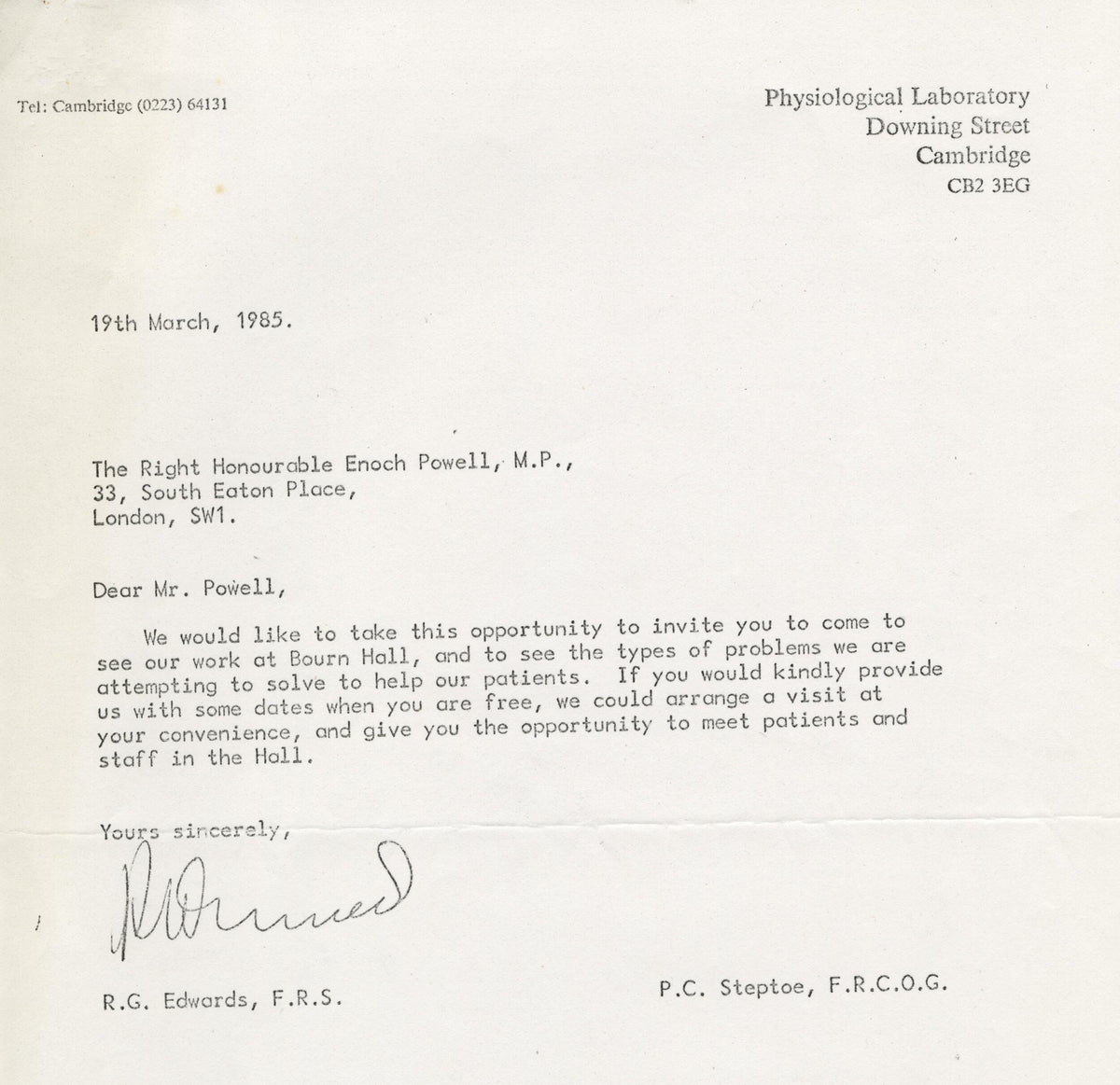
Enoch Powell's bill passes its second reading, 238 to 66
The Unborn Children (Protection) Bill would have made embryo research unlawful. It ran out of time.
March 1985
The Voluntary Licensing Authority is founded
By the MRC and the RCOG, to license IVF while Parliament deliberated. It is why British IVF was governed at all in the 1980s.
1 April 1985
A birth from cryopreserved embryos, readable in its abstract
Downing and colleagues, Melbourne. Included so the frozen-embryo question is resolvable rather than merely assertable.
In the collection →16 July 1985
The Surrogacy Arrangements Act receives Royal Assent
The first piece of Warnock actually legislated — five years before the main Act.
19 April 1986
The first pregnancy from cryopreserved oocytes
Chen, in The Lancet. A twin pregnancy, not a birth. The origin of the entire egg-freezing field.
In the collection →6 August 1986
India's first scientifically documented IVF birth: Harsha
At the ICMR's Institute for Research in Reproduction and KEM Hospital, Bombay.
In the collection →22 February 1987
Donum Vitae
An Instruction of the Congregation for the Doctrine of the Faith, signed by Cardinal Ratzinger, holding IVF illicit even between spouses. Not a papal document — but John Paul II approved it and ordered its publication, so it carries papal authority without being the Pope's own act. This museum previously called it “not a papal statement”, which was too simple.
November 1987
The UK White Paper, Cm 259
It offered Parliament two alternative clauses on embryo research, to be settled on a free vote. That device is what made 1990 possible.
22 March 1988
Patrick Steptoe dies
Twenty-two years before the Nobel Prize. The commonly given 21 March is wrong.
In the collection →April 1989
The Voluntary Licensing Authority renames itself Interim
“To emphasise the temporary nature of its existence.” A small date that tells the whole story of a profession waiting for Parliament.
April 1990
The first pregnancies after testing a biopsied embryo
Handyside and colleagues, by Y-specific PCR for X-linked disease. Not PGT-A.
In the collection →8 February 1990
The Lords free vote: 80 to 234
An amendment to delete the research-licensing power is defeated by nearly three to one.
2 April 1990
The Commons gives the Bill a second reading
Without a division. The argument was never about whether to legislate.
23 April 1990
The Commons free vote: 193 to 364, then 362 to 189
An amendment to prohibit embryo research is defeated, and the research clause carried. The decisive vote in the whole sequence.
1 November 1990
The Human Fertilisation and Embryology Act receives Royal Assent
1990 c. 37. The 14-day rule enters statute as a deeming provision about the primitive streak, not as a bare number of days.
7 November 1990
The HFEA legally comes into existence
By commencement order. It would be nine months before it could license anything — a distinction almost every account collapses.
1 August 1991
The Act comes into force and the HFEA begins licensing
Three different dates are routinely reported as one: Royal Assent, the Authority's constitution, and the day British IVF actually became a licensed activity.
The record corrected
1992–2022
The science kept moving, and so did the credit. This era is mostly about people going back through papers and notebooks and finding that the story had been told wrong.
4 July 1992
The first births after ICSI are reported
Palermo and colleagues. The title says pregnancies; the abstract reports four babies delivered. Now the majority insemination method worldwide.
In the collection →26 January 1996
The Dickey–Wicker Amendment (United States)
Federal funds barred from research destroying human embryos. Where Britain licensed, America defunded — and the two national stories diverge from here.
8 February 1997
Anand Kumar delivers the Subhas Mukerji Memorial Oration
In Calcutta, appealing for Mukherjee to be credited posthumously.
In the collection →10 April 1997
…and publishes the investigation
Having gone through the notebooks, correspondence and government papers, and concluded the claim was honest. It contains the only surviving text of Mukherjee's 1978 report.
In the collection →2002
ICMR acknowledges Subhas Mukherjee
In the national ART guidelines — twenty-four years after Durga was born and twenty-one after his death. A memorial oration followed, delivered by the ICMR Director in 2004.
In the collection →19 June 2006
A memorial to Mukherjee at NRS Medical College
Installed at the entrance of the academic building on the anniversary of his death and unveiled by West Bengal's Minister for Health. This museum previously dated it 2005 and attributed it to the Health Department; no source supports that object. Sources differ on whether it is a plaque or a bust.
In the collection →26 January 2010
T. C. Anand Kumar dies
Thirteen years after reopening a question the field had closed.
In the collection →4 October 2010
The Nobel Prize is announced
To Robert Edwards alone, “for the development of in vitro fertilization”. Steptoe had been dead twenty-two years and Purdy twenty-five; since 1974 the prize cannot be awarded posthumously.
In the collection →11 June 2011
Edwards is knighted
Gazetted in the Birthday Honours; letters patent 18 October 2011.
In the collection →13 March 2015
A blue plaque at Dr Kershaw's finally names Jean Purdy
Alongside Steptoe and Edwards — thirty years after her death, and thirty-four after Edwards first asked for it and was refused.
In the collection →June 2015
The Oldham notebooks are published
Johnson and Elder's archival reassessment of Purdy's role, and the source of almost everything this museum can say about her with confidence.
In the collection →9 March 2022
A plaque at the Royal Oldham Hospital
Honouring Jean Purdy and Sister Muriel Harris — the two women left off the original.
In the collection →Dates often given wrongly
A timeline is only worth building if it is right, and a surprising number of the dates in general circulation are not. These are the ones we found and changed.
The 14-day rule was not invented by Warnock
It was first proposed publicly in the United States, in 1979, by the Ethics Advisory Board of the Department of Health, Education and Welfare — five years before the Warnock report. Warnock endorsed it and argued for it, which is a real contribution and a different one.
Warnock's own reasoning is worth knowing. The report placed the primitive streak “at about fifteen days” and chose fourteen as a deliberately conservative point just short of it. The submissions before the Committee had proposed seventeen days, fourteen days, and the end of implantation; it took the middle one. And when the rule reached the statute book in 1990 it was not written as a number of days at all — the Act prohibits keeping an embryo after the primitive streak appears, then deems the streak to have appeared by day fourteen.
- “The Warnock Committee” is not its name. It is the Committee of Inquiry into Human Fertilisation and Embryology.
- The Warnock report has two dates and they are often swapped. Signed 26 June 1984; published 18 July 1984, a day fixed by the parliamentary record rather than by journalism.
- The Human Fertilisation and Embryology Act has three dates, routinely collapsed into one. Royal Assent 1 November 1990; the HFEA's own constituting provisions in force 7 November 1990; the licensing regime, and with it the Act in substance, 1 August 1991. “The HFEA was established in 1991” is half right.
- Victoria was the first jurisdiction, not the first country — and the United Kingdom was not the first country either. Victoria is an Australian state; the Infertility (Medical Procedures) Act 1984 was assented to on 20 November 1984 and commenced 1 July 1988. Both the Victorian Department of Health and VARTA say “jurisdiction”, and so should we. Nationally, Sweden and Spain both legislated in 1988, two years before the Human Fertilisation and Embryology Act.
- Candice Reed was not a Monash baby. The pregnancy was reported by the Johnston and Lopata team at the Royal Women's Hospital and the University of Melbourne. Monash's own timeline does not claim her.
- Zoe Leyland was born on 28 March 1984 and announced on 10 April. Anniversary pieces often use the April date. She was born at the Queen Victoria Medical Centre, not, as later summaries have it, at Monash.
- “The first frozen embryo baby, 1983” conflates a pregnancy with a birth. Trounson and Mohr reported a pregnancy in October 1983, and it was lost at twenty-four weeks. The first birth was 1984.
- Alastair MacDonald was born at Stobhill Hospital, Glasgow — not, as often given, at Glasgow Royal Infirmary.
- Donum Vitae is not a papal document — but “not a papal statement” was too simple, and this timeline used to say it. It is an Instruction of the Congregation for the Doctrine of the Faith, dated 22 February 1987 and signed by Cardinal Ratzinger; its closing formula records that “the Supreme Pontiff, John Paul II, approved this Instruction and ordered it to be published.” It carries papal authority without being the Pope's own act. The public release date we still could not confirm.
- Mouse IVF is 1968, not 1971, and Patrick Steptoe died on 22 March 1988, not the 21st — two errors this museum has corrected elsewhere and repeats here because they propagate through timelines particularly easily.
Corrections made in August 2026, after external review
Subhas Mukherjee died on 19 June 1981, not 19 July. This timeline printed July, following the title of the 1997 paper that rehabilitated him. That paper also says he died “44 days after” his transfer order of 5 June — but that arithmetic is its author's own, not a second witness. Against it: his memorial oration, his memorial centre, the NRS memorial and a fortieth-anniversary webinar were all held on 19 June, several organised by his widow and by the colleague who kept his papers for forty-two years; ICMR, which now holds those papers, gives 19 June; and his death was reported in the press on 21 and 26 June 1981. We have not seen a death certificate and do not call the question closed.
The “2005 West Bengal plaque” does not exist. It appears to be the 2006 NRS memorial, misdated by a year with the minister generalised into his department. We now show one object.
McLaren and Biggers, 1958, was missing entirely — the rung between Heape and Chang, and the paper Edwards needed. Added.
Era ranges and one ordering were wrong. Era I ran to 1950 while containing a 1951 event; Era VI claimed 1992–2026 while ending in 2022; and Bavister's April 1969 paper sat inside an era labelled 1960–1968, out of sequence. All three fixed.
What we could not pin down
-
The date of Royal Assent of Victoria's 1984 Act.Closed in August 2026: 20 November 1984, from the Act as printed, via AustLII. - The Waller Committee's report dates. Its name, chair and 1982 appointment are confirmed; the sequence of its reports is not.
- The exact date of the US Ethics Advisory Board report. Its Federal Register publication, 18 June 1979, is what we use.
- The public release date of Donum Vitae, and the day of publication of the 1987 White Paper.
- Louise Brown's time of birth. Universally given as 11.47 p.m. and almost certainly from the Lancet letter, but the publisher refused the page and we did not read it. The date is secure; we print no time.
- The HFEA's first chair. We found no authoritative source, so the timeline says nothing rather than guessing.
On the living. This timeline ends in 2022 and says almost nothing about the people born from these procedures, who are living private individuals and not exhibits. Louise Brown has written her own account, and that is the appropriate source for anything anyone wants to know about her.
Timeline | The IVF Museum

