The people who made IVF possible, from the rabbits of 1890 to the first frozen embryos and beyond, each remembered for what they achieved.
I
Meet the pioneers
IVF was not the work of one person. It was built over nearly a century by scientists, surgeons, nurses and technicians, many of whom never met.
This wing tells their stories, each person remembered for the discovery that was theirs. Some of them are famous. Others, like Samuel Buckley and Miriam Menkin, are given their due here at last.
Robert Edwards with Alan Gates and others at a meeting at Trinity College, Cambridge, 1956.Churchill Archives Centre, Cambridge. The Papers of Robert Edwards, EDWS 18/4/1.Louise Brown presenting Robert Edwards with the Barbara Eck Manning Award, 1991 to 1993.Churchill Archives Centre, Cambridge. The Papers of Robert Edwards, EDWS 18/6/6.Robert Edwards in 2010.Susannny, CC BY-SA 4.0, via Wikimedia Commons.
Remembered forEstablishing the timing and control of human oocyte maturation in vitro; achieving, with Bavister's medium, the first convincingly documented fertilisation of human oocytes in vitro in 1969; and the ten-year clinical programme with Steptoe and Purdy that produced the first birth from IVF.
A boy from Batley who would not let a question go. For more than a decade Robert Edwards chased one problem: how to bring a human egg and sperm together outside the body. He worked out the timing of human egg maturation, and the breakthrough came in 1969, when he joined forces with Barry Bavister, a graduate student in the laboratory next door, whose alkaline hamster medium let human sperm do their work in a dish [PI·13].
He was also a generous rediscoverer. When he found that eggs freed from their follicles began to mature on their own, he went to the library and found that Gregory Pincus had seen it in 1935 [PI·07]. Edwards went further, and worked out the timing in humans.
In 2010 he received the Nobel Prize, “for the development of in vitro fertilization”. Patrick Steptoe and Jean Purdy had died years before, and the Nobel cannot be given after death. Edwards never forgot them, and his own letters say they were his equals [PI·03].
RecognitionCBE, New Year Honours 1988. FRS 1984. Nobel Prize in Physiology or Medicine 2010, sole laureate. Knighted in the Birthday Honours 2011 — gazetted 11 June 2011, letters patent 18 October 2011. Co-founded Bourn Hall with Steptoe in 1980, after the NHS declined to support the work.
About the sources
CONFIRMED — two independent authorities. The Royal Society Biographical Memoir carries the dates in its title: “Sir Robert Geoffrey Edwards CBE. 27 September 1925 — 10 April 2013”, Biogr. Mems Fell. R. Soc. 61:81–102, DOI 10.1098/rsbm.2014.0020; the Nobel Foundation's laureate record agrees. The CBE and the knighthood were read directly from the London Gazette supplements (51171, 31 December 1987; 59808, 11 June 2011). Career detail from Johnson MH, RBMO 2011;23:245–262, DOI 10.1016/j.rbmo.2011.04.010, open access, read in full. The memoir's full text could not be reached — royalsocietypublishing.org refused every route — so the dates come from its registry metadata, which is where the Royal Society puts them. Since 1974 the Nobel Foundation's statutes have barred posthumous awards; the 2010 prize was share 1/1.
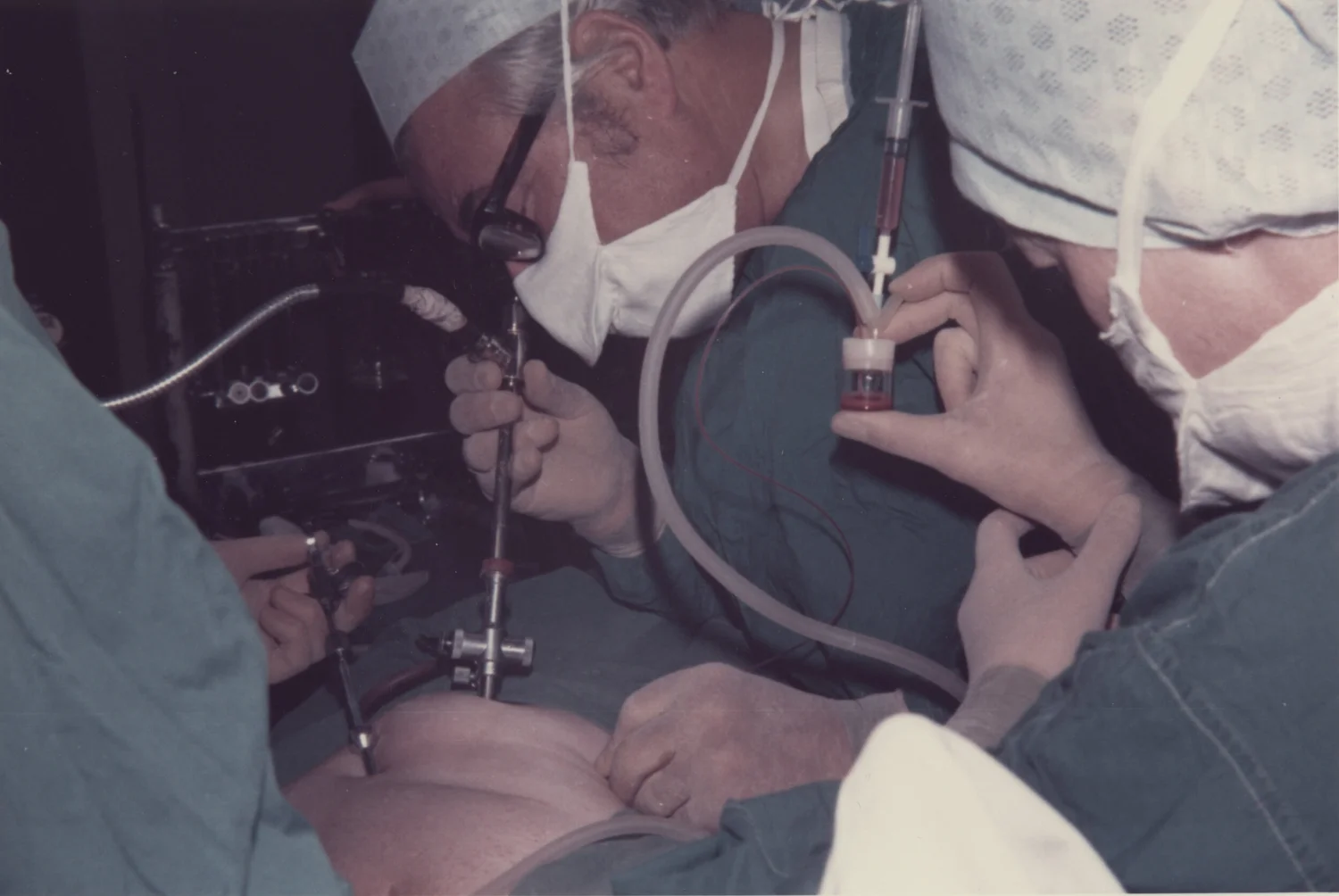
Patrick Steptoe performing a laparoscopic procedure during the clinical research at Oldham, c.1968 to 1978.Churchill Archives Centre, Cambridge. The Papers of Robert Edwards, EDWS 18/1/4.Patrick Steptoe holding the first Greek IVF baby, 20 January 1982.Dimis Argyropoulos / OTE Group Museum, CC BY-SA 4.0, via Wikimedia Commons.
Remembered forIntroducing and defending laparoscopy in British gynaecology against sustained hostility, and then applying it to the laparoscopic aspiration of preovulatory follicles.
Without Patrick Steptoe's telescope, there would have been no Louise. He brought laparoscopy into British gynaecology and defended it for years against fierce criticism. His textbook Laparoscopy in Gynaecology appeared in 1967.
That small instrument changed everything. Before Steptoe, Edwards could only work with immature eggs taken from removed ovarian tissue, unpredictable material that had to be ripened in the dish. Steptoe could collect eggs that had matured naturally, directly from the ovary of a living patient, at exactly the right moment in her cycle. That made a clinical programme possible.
The work ran at Oldham District and General Hospital and at Dr Kershaw's Cottage Hospital, now a hospice. And a lovely detail: when Steptoe died, his Royal Society memoir was written by his friend and partner, Robert Edwards.
RecognitionCBE, New Year Honours 1988 — the same Gazette list as Edwards, on the following page. FRS. No knighthood. No Nobel: he died in 1988, twenty-two years before the award.
About the sources
CONFIRMED. Royal Society Biographical Memoir title, verbatim: “Patrick Christopher Steptoe, C. B. E., 9 June 1913 – 22 March 1988”, Biogr. Mems Fell. R. Soc. 42:433–452, DOI 10.1098/rsbm.1996.0027. The death date is 22 March; the 21 March in wide circulation is wrong. CBE read directly from London Gazette supplement 51171. His FRS election year (1987) and the year he became consultant at Oldham are both unresolved — two sources give 1951 and 1961 for the consultancy.
PI·03
Jean Marian Purdy
25 April 1945 – 16 March 1985
State Registered Nurse, working as an embryologist · Oldham and Bourn Hall
Jean Purdy. Undated.Churchill Archives Centre, Cambridge. The Papers of Robert Edwards, EDWS 18/7/8.Bunny Austin, Barbara Rankin, Robert Edwards and Jean Purdy, October 1978. Barbara Rankin holds a cartoon by Alan Handyside about the birth of Louise Brown.Churchill Archives Centre, Cambridge. Barbara Rankin's scrapbooks, BARA 3.
Remembered forRunning the laboratory of the Oldham programme: recording and organising most of the data, preparing and testing the culture media, and caring for patients. Named author on at least eleven primary research papers with Edwards and Steptoe, seven of them reporting the Oldham work.
Jean Purdy was there at every step. She ran the laboratory of the Oldham programme: she recorded and organised most of the data, prepared and tested the culture media, cared for the patients, and was a constant support to Edwards. The historians who studied the Oldham notebooks believe she probably spent more time in Oldham than Edwards himself. She was a named author on at least eleven research papers with Edwards and Steptoe.
How essential was she? When her mother fell terminally ill, between July 1974 and February 1975, the work stopped completely until she could return.
After Louise, she helped build Bourn Hall. She is remembered as the person who found the Jacobean manor house that became the clinic, and served as its technical director from 1980. The first Bourn Hall science notebook is written in only two hands, hers and Edwards'. Bourn Hall today honours her as a co-founder.
RecognitionNone in her lifetime. Edwards fought for her twice and lost twice — see §IV. A blue plaque naming all three was unveiled at Dr Kershaw's Hospice on 13 March 2015, thirty years after her death; a further plaque at the Royal Oldham Hospital on 9 March 2022 honours Purdy and Sister Muriel Harris, the two women left off the original.
About the sources
CONFIRMED — registry-grade, and the best-attested dates in this wing. Johnson MH & Elder K, Reprod Biomed Soc Online 2015;1(1):46–57, DOI 10.1016/j.rbms.2015.04.005, open access, read in full — citing the civil birth register, volume 3B, page 820, and recording that she died of malignant melanoma aged 39. Her nursing registration is cited to the NMC register, pin 375932. Second peer-reviewed account: Gosden R, Human Fertility 2018;21(2):86–89, DOI 10.1080/14647273.2017.1351042. Notes on two points sometimes told differently. Bourn Hall Clinic calls her a co-founder; the peer-reviewed literature calls her a pioneer, the third member of the team and, in Johnson's most careful formulation, a laboratory assistant. Her finding of the house and the title of technical director rest on testimony rather than surviving documents. She was not involved in laparoscopy or egg collection; a widely reproduced photograph of her apparently collecting eggs is described by the historians who found it as posed. She trained as a nurse at Addenbrooke's and registered SRN on 5 December 1966; she held no degree, and “embryologist” describes her work rather than a qualification.
Subhas Mukherjee.Photographer and rights holder to be confirmed.
Remembered forThe birth, in Calcutta on 3 October 1978, of a girl conceived by in-vitro fertilisation — seventy days after Louise Brown, and by a different method: gonadotrophin stimulation, oocyte recovery through a posterior colpotomy, and the freezing and thawing of embryos before transfer.
In Calcutta, in 1978, a doctor with almost no resources achieved something extraordinary. On 3 October, seventy days after Louise Brown, a baby girl named Durga was born, conceived by a method he and his small team had developed, which included freezing and thawing the embryo before transfer.
Subhas Mukherjee had trained in Calcutta and earned a second doctorate in Edinburgh in 1963, under John A. Loraine. His Edinburgh thesis still survives in the university archive.
His work was dismissed by a committee with no specialist in reproductive medicine. He was refused permission to travel to Kyoto to present it, and transferred to a post far from his research. He died on 19 June 1981, by his own hand. Sixteen years later, T. C. Anand Kumar went through his papers and gave him back his place in history [PI·16]. His full story is told on his own page.
RecognitionNone in his lifetime. Since then: acknowledged by ICMR in the national ART guidelines from 2002; a memorial oration delivered by the ICMR Director in 2004; a memorial at NRS Medical College, Kolkata, unveiled on 19 June 2006 by West Bengal's Minister for Health; a posthumous honorary DSc from the Indian Statistical Institute in 2011; an ICMR award in his name from 2012; a statue near his birthplace at Hazaribagh in 2018.
About the sources
Chronology from Anand Kumar TC, Current Science 1997;72(7):526–531, obtained via the Internet Archive and read page by page. On the death date this museum has changed its position and was previously wrong.This museum printed 19 July 1981 until August 2026 and was wrong. The July date comes from the title of T. C. Anand Kumar's 1997 paper, which also says he died “44 days after” the transfer order of 5 June — but that arithmetic is Anand Kumar's own subtraction, not a second witness. Against it: his memorial oration (1983), his memorial centre (1985), the NRS plaque (2006) and a fortieth-anniversary webinar (2021) were all held on 19 June, several organised by his widow and by Sunit Mukherjee, the colleague who kept his papers for forty-two years; ICMR-NIRRCH, which now holds those papers, gives 19 June; and his death was reported in the press on 21 and 26 June 1981. No source gives 19 July independently of the 1997 title. A variant of 18 June rests on one 2024 article and no document. We have not seen a death certificate or an inquest record, and do not claim the question is closed. Sources: ICMR-NIRRCH commemorative booklet (Mukherjee & Mehta). Mukherjee & Mehta, Indian J Hist Sci 2024;59:113–121. Khastgir & Khastgir, J Med Biography 2025;33(2):105–108. Press reports cited in Ferber, Marks & Wahlberg 2020, nn. 174 and 182. His frozen-embryo priority is discussed fully on The Founding Papers. A “West Bengal Health Department plaque of 2005” appears in some accounts; no source supports it, and it appears to be the 2006 memorial, misdated.
III
The wider record
Thirteen more, in order of birth: from the man who moved the first mammalian embryo in 1890 to the man who, in 1997, gave a forgotten colleague back his place in history.
PI·05
Walter Heape
1855 – 10 September 1929
Reproductive biologist · Prestwich and Cambridge
Remembered forThe first successful mammalian embryo transfer, 27 April 1890 — and, ten years later, the vocabulary of the reproductive cycle that the field still uses.
The man who first moved a living embryo from one mother to another. On 27 April 1890, in a small laboratory in his own home at Prestwich, near Manchester, Walter Heape transferred two Angora rabbit embryos into a Belgian hare doe. Two Angora babies were born. Embryo transfer had begun.
He was not trying to invent anything practical. He wanted to know whether a foster-mother could change the young she carried, and he never imagined what his experiment would one day mean.
He gave the field its language too. The words oestrus, pro-oestrus, met-oestrus, di-oestrus and an-oestrus all come from a single paper he wrote in 1900, and in 1905 he discovered induced ovulation in the rabbit.
RecognitionFRS 1906. On his review of artificial insemination the referee — Francis Galton — wrote: “Originality in the strictest sense, is not the strong point of Heape's paper, but it seemed to me of eminent value as putting into an authoritative form a great quantity of material scattered far and wide.”
About the sources
Death date from the obituary by F. H. A. Marshall, his contemporary and the man who adopted his terminology: Nature 1929;124(3128):588–589, DOI 10.1038/124588a0. Birth year corroborated by Biggers JD, J Reprod Fertil 1991;93:173–186, DOI 10.1530/jrf.0.0930173, read in full — the source of all three corrections. No exact birth date found. No Royal Society memoir exists: that series began in 1932, after his death. From Biggers' centenary study: the 1890 transfer was done at Heape's home laboratory in Prestwich, not Cambridge (the paper was communicated by Michael Foster and described Heape as Balfour Student there). He was notified of his election as Balfour Student on 1 October 1890, after the experiment. He was never a professor, although at least one archival authority calls him one.
PI·06
Samuel Buckley
1847 – 30 May 1910
Physician and surgeon · Manchester
Remembered forPerforming the surgery for Heape's 1890 embryo transfer — the first in any mammal.
The surgeon's hands behind the first embryo transfer. Samuel Buckley performed the delicate surgery for Walter Heape's experiment in 1890, and Heape thanked him by name in the last paragraph of his paper.
He was a respected Manchester doctor: Resident Medical Officer at Manchester Royal Infirmary, physician at the Manchester Northern Hospital for Diseases of Women and Children, and president of the North of England Obstetrical and Gynaecological Society. He was also Medical Officer of Health for Prestwich, the district where Heape's home laboratory stood. His name helps tell us exactly where the first embryo transfer took place.
RecognitionLittle for his part in the 1890 experiment, until now.
About the sources
REGISTRY. Plarr's Lives of the Fellows, Royal College of Surgeons of England, entry “Buckley, Samuel (1847–1910)” — the authoritative biographical register of RCS Fellows, which is precisely the body whose fellowship Heape cites. Corroborated on the hospital appointment and society presidency by Biggers 1991. Exact birth date not established. His Lancet obituary (1910, i, 1793) is cited by two independent sources but could not be read; pre-1946 Lancet is outside the databases available here, and it would probably settle the birth date. Register: LSA 1868; MRCS 1868; FRCS 1873; MB Lond. 1880; MD 1885; MRCP 1894.
PI·07
Gregory Goodwin Pincus
9 April 1903 – 22 August 1967
Endocrinologist · Worcester Foundation for Experimental Biology
Gregory Pincus, 1939.ACME Newspictures, 1939. Public domain in the United States, via Wikimedia Commons.
Remembered forDemonstrating, with E. V. Enzmann in 1935, that a mammalian oocyte released from its follicle resumes meiosis by itself — the basis of all in-vitro maturation. And, later, co-development of the oral contraceptive.
A bold scientist, and the discoverer of something beautiful. In 1935 Gregory Pincus and E. V. Enzmann showed that an egg released from its follicle begins to mature all by itself. Every in-vitro maturation since rests on that finding, and it is the very observation Robert Edwards picked up at Mill Hill and built his life's work on [PI·01].
His earlier claim of rabbit IVF in 1934 was finally made good by Min Chueh Chang in 1959 [PI·10], and the full story is told in The Animal Work. Pincus later co-developed the oral contraceptive and changed the lives of millions of women.
RecognitionElected to the National Academy of Sciences; the NAS Biographical Memoir was written by Dwight J. Ingle.
About the sources
DIRECT. NAS Biographical Memoir (Ingle, 1971), read; corroborated by American National Biography, DOI 10.1093/anb/9780198606697.article.1301310. The 1934 claim and why it is not accepted as the first mammalian IVF are set out in The Animal Work. Pincus's memoir says the Worcester Foundation invited gifted young scientists; Chang's memoir says he applied for the fellowship himself.
PI·08
John Charles Rock
24 March 1890 – 4 December 1984
Gynaecologist · Free Hospital for Women, Brookline
Remembered forThe 1944 claim, with Miriam Menkin, of in-vitro fertilisation and cleavage of human ovarian eggs — contested. Co-development of the oral contraceptive, and its clinical trials.
The first doctor to try human IVF. In 1944, at the Free Hospital for Women near Boston, John Rock and Miriam Menkin reported that human eggs had begun to divide in a dish. It came too early: nobody yet knew that sperm must be prepared before they can fertilise an egg, and the result was never repeated. But it showed the world that the question could be asked.
Rock was a doctor of conviction. He taught contraception in a state where it was illegal, helped develop the pill, and at seventy began campaigning for the Church to accept it.
RecognitionExtensive in his lifetime.
About the sources
Birth and career DIRECT from the Harvard Countway finding aid, John C. Rock papers, H MS c161 (recovered via the Internet Archive; Harvard's own catalogue rate-limited every request). The archive gives only “in 1984… 94 years old”; the day of death is search-verified from a broadcaster's page and is consistent with the birth date. Year corroborated by American National Biography and by the JAMA death notice, 1985;253(1):18. The 1944 claim is widely doubted; the parthenogenesis explanation often repeated could not be verified. Menkin's papers at the Countway Library were separated out of Rock's in 2015.
PI·09
Miriam Friedman Menkin
1901 – 1992
Laboratory scientist · Free Hospital for Women, Brookline
Remembered forThe bench work of the 1944 Rock–Menkin experiment, and the change in protocol that produced its result.
The scientist at the bench in 1944. Miriam Menkin was born in Riga and came to the United States as a small child. She earned degrees from Cornell and Columbia, and had published in the Journal of Experimental Medicine long before she joined John Rock. Before that, she had worked on fertility research with Gregory Pincus.
For six years she worked patiently through nearly eight hundred eggs. On 3 February 1944 she changed the routine: one wash instead of three, a more concentrated sample of sperm, a full hour together instead of half. That was the day she saw the first divisions.
The famous short paper in Science in 1944 was “Rock and Menkin”. The full report four years later carried her name first: “Menkin and Rock”.
RecognitionNone is recorded in her lifetime.
About the sources
DIRECT for education, employers, publications and author order — Harvard Countway finding aid, Miriam F. Menkin papers, H MS c452, and NLM/PubMed author strings for both papers. Life dates: years only. The day-level dates in circulation are uncited even where they appear and we could not verify them. The 3 February 1944 date is attributed, not confirmed by us — it traces to Rodriguez S, Women's Studies 2015;44(4):451–467, DOI 10.1080/00497878.2015.1013215, which the publisher would not let us read. One further caution: a historian of the period calls the egg hunt “ethically somewhat perilous” and “notorious”. If this museum credits her scheduling work, it carries that judgement with it. No award, prize, honorary degree or society honour was found, including in the archival finding aid; this is an absence of evidence rather than proof of absence. TIME named her as “his assistant, Miriam F. Menkin.”
PI·10
Min Chueh Chang
10 October 1908 – 5 June 1991
Reproductive biologist · Worcester Foundation for Experimental Biology
Remembered forCo-discovery of capacitation in 1951, independently of Austin; and in 1959 the first unequivocal demonstration of mammalian in-vitro fertilisation, proved by the birth of live young.
The man who made mammalian IVF certain. In 1959 Min Chueh Chang fertilised black rabbit eggs with black rabbit sperm in a dish, and transferred them to a white mother. She gave birth to black babies. There could be no doubt: IVF worked in mammals.
He set himself the highest possible standard, living young rather than pictures under a microscope, and it took him fourteen years of patient work at the Worcester Foundation to meet it.
He arrived in 1945 on a one-year fellowship with Gregory Pincus, was given a room in the new foundation and served as its night watchman. With Colin Austin he also discovered that sperm must be prepared before they can fertilise an egg [PI·11].
RecognitionOrtho Medal, American Fertility Society, 1961; Hartman Award, 1971; Francis Amory Prize, American Academy of Arts and Sciences, 1975. Elected to the National Academy of Sciences in 1990 — at eighty-two, one year before he died.
About the sources
DIRECT. NAS Biographical Memoir by Roy O. Greep, Biographical Memoirs vol. 68 (1995), pp. 45–62, read in full; corroborated by the NAS member directory and by American National Biography. Two cautions. The memoir itself contains typographical errors — it prints his Cambridge PhD as 1961, an impossible misprint for 1941, and misspells Austin, Bavister and Toyoda. And a “1954 Albert Lasker Award” it lists is not a Lasker Foundation award; the Lasker database returns no Chang. We do not print it. On whether he was ever considered for a Nobel: our check of the nomination archive failed silently and returned nothing usable, so we report nothing. Chang could not reproduce his patron Pincus's 1934 result on arrival in 1945. He was not recruited by Pincus, as is sometimes said; he sought the fellowship himself.
PI·11
Colin Russell Austin
12 September 1914 – 29 June 2004
Charles Darwin Professor of Animal Embryology · Cambridge
Remembered forCo-discovery of capacitation in 1951, independently of Chang; coining the word itself in 1952; and setting out in 1961 the five criteria that any claim of mammalian IVF had to meet.
A protector of the work when it needed one most. In 1951 Colin Austin, working independently of Chang, discovered that sperm must spend time in the female body before they can fertilise an egg. In 1952 he gave it a name, capacitation. In 1961 he set out the five tests any claim of mammalian IVF would have to pass.
His other gift was courage. Several senior Cambridge academics were deeply opposed to human IVF, and Austin defended Edwards and Steptoe from his Charles Darwin chair. Edwards never forgot it: “I would like to stress my own deep debt to him during the most difficult period of human in-vitro fertilization, when he was a clear thinking supporter of the work, prepared to defend it publicly when there were few others around.”
His first graduate student was Barry Bavister [PI·13].
RecognitionCharles Darwin Professor 1967–1981, a chair created for him. Fellow of the Australian Academy of Science, 1987, at seventy-two. On retirement he returned to Queensland and finished the thirteen-volume Reproduction in Mammals.
About the sources
Birth DIRECT from the Australian Academy of Science memoir by R. V. Short, Hist Rec Aust Sci 2014;25(2):264–272, DOI 10.1071/HR14024, read in full; day of death from Who Was Who, since the Academy memoir gives no death date at all. Note a contradiction inside that memoir: its abstract opens “English by birth” while its body says “born in Sydney”. Both are Short's; he means English parentage. Note also that Crossref indexes the 1961 criteria paper under a misspelt author and the wrong year — use PubMed, PMID 13863326. The five criteria are in International Review of Cytology 1961;12:337–359, not in his book The Mammalian Egg of the same year. He did not supervise Edwards, whose doctorate was from Edinburgh; this claim propagates from a memoir abstract.
PI·12
Wesley Kingston Whitten
1 August 1918 – 24 May 2010
Reproductive biologist · Australia and the Jackson Laboratory
Remembered forEstablishing that early mammalian embryos need defined chemistry rather than a mysterious tubal factor — and the media that followed from it.
The man who turned embryo culture into chemistry. In 1956 Wesley Whitten discovered that the hidden enemy of the growing mouse embryo was pH, and solved it with bicarbonate buffering. A year later he showed that a pinch of glycine could replace the last biological ingredient, and concluded that mouse eggs “do not require any specific tubal factor at this stage”. There was no secret ingredient in the body to copy, and that made growing a human embryo in a dish thinkable.
He is the W in BWW, the sperm medium of the early IVF laboratories, and his medium is the ancestor of the mouse embryo test still widely used to check IVF culture media. See The Animal Work.
RecognitionFellow of the Australian Academy of Science, whose biographical memoir records him.
About the sources
DIRECT. Australian Academy of Science memoir, Shelton JN & McCullagh PJ, Hist Rec Aust Sci 2011;22(2):291–303, DOI 10.1071/HR11009, read in full: born at Macksville, New South Wales, on 1 August 1918; died in Canberra on 24 May 2010. BWW was principally a sperm-preparation medium.
PI·13
Barry D. Bavister
born 1943 — living
Reproductive biologist · Cambridge, Wisconsin, New Orleans
Remembered forFinding, as a graduate student in 1968, that hamster fertilisation in vitro is steeply pH-dependent — and so producing the medium in which human fertilisation in vitro was first documented.
The graduate student whose medium made history. In 1968, at twenty-five, Barry Bavister was studying hamster fertilisation as Colin Austin's first graduate student [PI·11]. He discovered that simply making the medium more alkaline let far more eggs be fertilised.
Robert Edwards, who shared laboratories with Austin, saw its promise at once. In Bavister's own words: “When Bob learned of my success with hamster gametes, he suggested applying my culture medium to support fertilisation of in vitro matured human eggs.” It worked, and his name sits in the middle of the famous 1969 Nature paper: Edwards, Bavister and Steptoe.
He went on to produce the first IVF rhesus monkey, born in 1983.
RecognitionIETS Pioneer Award, 2019. Freeport-McMoRan Endowed Chair, University of New Orleans, from 2000.
About the sources
SEARCH-VERIFIED, strong. Birth year from the official award citation published in a peer-reviewed journal: “Recipient of the 2019 IETS Pioneer Award: Dr Barry Bavister”, Reprod Fertil Dev 2019;31(3):vii–viii, DOI 10.1071/RDv31n3_PA. Living status established from a signed commentary he published on 1 September 2025; no death record exists in any database searched. He should not be given a death date. The 1972 PhD year comes from the award citation and independently from Johnson 2011. He was Austin's student, not Edwards'. His Cambridge PhD is dated 1972 by two independent sources. He was second author on the 1969 Nature paper; Edwards made him first author on their second paper that year, which Bavister notes Edwards actually wrote.
PI·14
David Gordon Whittingham
dates not established
Experimental embryologist · Cambridge and St George's, London
Remembered forMouse in-vitro fertilisation in 1968; the first survival of frozen mouse embryos in 1971; and, with Leibo and Mazur in 1972, the first live young from frozen mammalian embryos.
A quiet giant of the laboratory. David Whittingham appears in all three great threads of the animal work. He achieved mouse IVF in 1968, showed that frozen mouse embryos could survive in 1971, and in 1972, with Stanley Leibo and Peter Mazur, saw the first healthy young born from frozen mammalian embryos.
That 1972 paper is the ancestor of the frozen embryo transfer, now the majority of IVF transfers worldwide, and of the great mouse embryo banks that serve science today. He is also the third initial in BWW.
RecognitionMarshall Medal of the Society for Reproduction and Fertility, 1998. Emeritus Professor of Experimental Embryology at St George's, University of London.
About the sources
UNVERIFIED — and this museum prints no dates for him. No birth year, no death record and no obituary was found in Europe PMC, Crossref or general search, and we looked specifically. He must not be described as deceased. Institutions are confirmed from author affiliations printed on his own papers: the Physiological Laboratory, Cambridge (1971), then the MRC Experimental Embryology and Teratology Unit at St George's Hospital Medical School, which he headed. Last indexed publications 2003. This is the weakest record in the wing and the one most in need of a direct enquiry. Life dates not established. The 1971 Nature paper is his alone and reports survival without offspring; Leibo and Mazur join for 1972. Not FRS; no Royal Society memoir; no national honour located.
PI·15
Ryuzo Yanagimachi
27 August 1928 – 27 September 2023
Reproductive biologist · Worcester Foundation and Hawaiʻi
Remembered forWith Chang, in-vitro fertilisation of hamster eggs in 1963 and 1964 — the system that became the standard assay for capacitation and the workbench on which human IVF conditions were worked out.
The scientist who gave IVF its workbench. With Min Chueh Chang in 1963, Ryuzo Yanagimachi fertilised golden hamster eggs in a dish. The hamster became the standard way to study fertilisation, and it was the hamster system that Barry Bavister refined into the medium of the first human fertilisation in 1969 [PI·13]. For many years, the hamster egg test was also used in clinics to check human sperm.
He was generous about others, too. Of Colin Austin he said in 1986: “If it were not for Dr Austin, the success of human in vitro fertilization, for example, would have been set back at least a decade, or perhaps never occurred.”
His later work, including ICSI in mice, belongs to the story of the modern laboratory.
RecognitionElected to the National Academy of Sciences, 2001. Awarded the Kyoto Prize in 2023, and died that year.
About the sources
DIRECT. Official institutional record: University of Hawaiʻi, John A. Burns School of Medicine, “In Memoriam: Dr. Ryuzo Yanagimachi” (September 2023), giving both exact dates; corroborated by the UH System memorial and by peer-reviewed obituary titles in RBMO, J Reprod Dev and PNAS, and by the Inamori Foundation's own laureate page.
PI·16
T. C. Anand Kumar
1936 – 26 January 2010
Reproductive biologist · Institute for Research in Reproduction, Bombay
Remembered forThe scientific documentation of India's first IVF birth, Harsha, on 6 August 1986 — and then, in 1997, the investigation that restored Subhas Mukherjee's claim to the record.
The man who gave Subhas Mukherjee back his place in history. In 1986 T. C. Anand Kumar was medical director of the institute in Bombay where Harsha, India's first scientifically documented IVF baby, was born on 6 August, and he was one of the two scientists publicly identified with that success.
Then he did something remarkable. In Calcutta, on 8 February 1997, he gave the Subhas Mukerji Memorial Oration and appealed for Mukherjee to be honoured. Two months later he published his investigation. He had gone through Mukherjee's notebooks, letters and government papers, cleared his name, and argued that the credit was his. He even wrote that his own 1986 birth had been called India's first “scientifically documented” one only “because the details of Mukerji's work were not then available”.
Within months, India's medical establishment began to recognise Mukherjee's work. Told of it, Mukherjee's widow said it would not bring him back.
RecognitionShanti Swarup Bhatnagar Award; Sanjay Gandhi National Award; Jawaharlal Nehru Fellow. Founder-President of the Indian Society for the Study of Reproduction & Fertility, which runs a memorial oration in his name.
About the sources
PARTIAL — the weakest dates in this wing. The year range comes from the title of the peer-reviewed obituary, Mehta R, RBMO 2010;20(4):443, DOI 10.1016/j.rbmo.2010.02.008; the full text was refused by the publisher on every route, so we have the title's dates and not the obituary's contents. The exact death date is search-verified from trade press only. We print no exact birth date. A second obituary in the Indian Journal of Medical Research is the likely source of one and could not be obtained. The 1986 and 1997 events are DIRECT from Bharadwaj A, Reprod Biomed Soc Online 2016;2:54–61, DOI 10.1016/j.rbms.2016.06.002, open access, read in full. Bharadwaj writes that the 1986 team was “popularly believed” to be headed by Anand Kumar and Indira Hinduja; his article is about how credit diverged between peers and the press.
PI·17
Anne Laura Dorinthea McLaren
26 April 1927 – 7 July 2007
Developmental biologist · Royal Veterinary College, MRC Mammalian Development Unit, Cambridge
Remembered forWith John Biggers in 1958, the first mammals born after part of their preimplantation development had taken place outside a body. The systematic parameters of mouse embryo transfer, with Donald Michie, 1956–59. A decade on the Warnock Committee and the HFEA.
Anne McLaren proved that a life could begin in glass and still flourish. In 1958, with John Biggers, she cultured mouse embryos for a day, transferred them to foster mothers, and saw normal, healthy young born. It showed that time outside the body need not cost an embryo its future, the missing step between Heape's transfer and Chang's fertilisation, and it came a year before Chang. It was the paper Robert Edwards needed.
She went on to serve on the Warnock Committee, where Mary Warnock called her indispensable. She argued for the primitive streak as the natural limit for embryo research and proposed the term “pre-embryo”. She later served on the HFEA, and became the first woman to hold office in the Royal Society in its 332 years.
RecognitionFRS 1975. Scientific Medal, Zoological Society of London, 1976. Royal Medal of the Royal Society, 1990. DBE 1993. Japan Prize 2002, with Andrzej Tarkowski. March of Dimes Prize 2007. Foreign Secretary of the Royal Society 1991–96 and Vice-President 1992–96 — the first woman to hold office in the Society's 332 years.
About the sources
Life dates from the title of her Royal Society Biographical Memoir: Clarke A & Johnson MH, Biogr. Mems Fell. R. Soc. 2023;74:309–337, DOI 10.1098/rsbm.2022.0053 — the same class of authority this wing uses for Edwards and Steptoe. The 1958 paper is McLaren A & Biggers JD, Nature 1958;182(4639):877–878, DOI 10.1038/182877a0; note that PubMed carries a corrupted form of its title. Warnock role from the memoir abstract and from Wilson D, The Making of British Bioethics, Manchester University Press 2014. The memoir body is paywalled and we read only its abstract and metadata. No fertilisation took place in glass in the 1958 experiment; the embryos were fertilised in the mother. The Royal Society's public exhibit about her describes the paper as proving it possible to “join sperm and eggs outside the mother's body”, which is not what it shows. The Warnock report does not attribute the primitive-streak argument to her, and the fourteen-day line had been proposed publicly in the United States five years earlier.
IV
The hands at the bench
Again and again in this story, the person whose hands did the work was the one history forgot. Here are three of them.
1890. The surgery that made the first mammalian embryo transfer possible was performed by Samuel Buckley[PI·06], thanked once in Heape's paper and rarely since. He was a respected Manchester physician, and the Medical Officer of Health for the very district where the experiment took place.
1944.Miriam Menkin[PI·09] held a master's degree from Columbia and had published in the Journal of Experimental Medicine fourteen years before the change she made at the bench produced the Rock and Menkin result. TIME called her “his assistant”.
1978.Jean Purdy[PI·03] was a named author on at least eleven research papers with Edwards and Steptoe, but not on the page that announced Louise's birth.
Edwards fights for Jean
In July 1980 Robert Edwards began a long exchange of letters with the hospital at Oldham about a commemorative plaque. He asked for two plaques, so that Jean Purdy, Muriel Harris, James Holmes, John Webster and the theatre and midwifery staff could all be named. He was told only one was possible.
In January 1981 he wrote back: “I feel strongly about the inclusion of the names of the people who helped with the conception of Louise Brown. I feel this especially about Jean Purdy, who travelled to Oldham with me for 10 years, and contributed as much as I did to the project. Indeed, I regard her as an equal contributor to Patrick Steptoe and myself.” He closed: “I feel this must be my last letter on this subject.”
The plaque went up without her, and so did the next ones. Then, on 13 March 2015, a blue plaque naming all three was unveiled at Dr Kershaw's Hospice, thirty years after Jean died. On 9 March 2022 a further plaque at the Royal Oldham Hospital honoured Jean Purdy and Sister Muriel Harris together.
These pages are, in part, a thank-you to the people at the bench.
V
Life dates
The dates of birth and death for everyone in this wing, with the source for each.
Every person in this wing, with the authority for their dates
Person
Dates
Authority
Standing
Anne Laura Dorinthea McLaren
26 Apr 1927 – 7 Jul 2007
Royal Society Biographical Memoir title
Confirmed
Robert Geoffrey Edwards
27 Sep 1925 – 10 Apr 2013
Royal Society Biographical Memoir title; Nobel Foundation
Confirmed
Patrick Christopher Steptoe
9 Jun 1913 – 22 Mar 1988
Royal Society Biographical Memoir title (written by Edwards)
Confirmed
Jean Marian Purdy
25 Apr 1945 – 16 Mar 1985
Civil birth register vol. 3B p. 820, via Johnson & Elder 2015
Confirmed
Subhas Mukherjee
16 Jan 1931 – 19 Jun 1981
ICMR-NIRRCH; four memorials held on 19 Jun; press reports 21 and 26 Jun 1981. Anand Kumar 1997 gives 19 Jul — see card
Partial
Walter Heape
1855 – 10 Sep 1929
Marshall obituary, Nature 1929; Biggers 1991
Partial
Samuel Buckley
1847 – 30 May 1910
Plarr's Lives of the Fellows, RCS England
Partial
Gregory Goodwin Pincus
9 Apr 1903 – 22 Aug 1967
NAS Biographical Memoir (Ingle); American National Biography
Confirmed
John Charles Rock
24 Mar 1890 – 4 Dec 1984
Harvard Countway finding aid; day of death search-verified
Partial
Miriam Friedman Menkin
1901 – 1992
Harvard Countway finding aid — years only
Partial
Min Chueh Chang
10 Oct 1908 – 5 Jun 1991
NAS Biographical Memoir (Greep); NAS directory; ANB
Confirmed
Colin Russell Austin
12 Sep 1914 – 29 Jun 2004
Australian Academy of Science memoir; Who Was Who
Confirmed
Wesley Kingston Whitten
1 Aug 1918 – 24 May 2010
Australian Academy of Science memoir
Confirmed
Barry D. Bavister
born 1943 — living
IETS Pioneer Award citation; his own signed commentary, 2025
Partial
David Gordon Whittingham
not established
No obituary traced; not on his society's In Memoriam page; research-active to at least 2008
Unverified
Ryuzo Yanagimachi
27 Aug 1928 – 27 Sep 2023
University of Hawaiʻi official memorial; three peer-reviewed obituaries
Confirmed
T. C. Anand Kumar
1936 – 26 Jan 2010
RBMO obituary title; death day from trade press only
Partial
VI
Sources and notes
The gaps, itemised, because a wing about people who were left out of the record should be candid about the limits of the record.
Read the notes on sources
David Whittingham's dates — nothing at all. No birth year, no death record, no obituary, in any database searched. He is displayed with no dates and is not described as deceased. The man whose work underlies the entire embryo-cryopreservation industry is the least documented person in this wing.
Miriam Menkin's exact dates — years only. The day-level dates in circulation are uncited even where they appear.
T. C. Anand Kumar's exact birth date — his obituary was refused by its publisher on every route, and a second obituary that would probably settle it is gated.
Exact birth dates for Walter Heape and Samuel Buckley — years only. Buckley's Lancet obituary would likely settle his and is retrievable by anyone with medical-library access.
Whether M. C. Chang was ever considered for a Nobel Prize. Our check of the nomination archive failed silently and returned nothing usable. That is a failed check, not a negative finding, and we report nothing on the question.
The 3 February 1944 date for Menkin's protocol change is attributed to a peer-reviewed article we could not read, not confirmed by us.
Steptoe's FRS election year and the year he became consultant at Oldham — two sources give 1951 and 1961 for the latter, and we could not resolve it.
The full texts of the Royal Society Biographical Memoirs of Edwards and Steptoe could not be reached; their dates come from the memoirs' registry metadata, which is where the Royal Society puts them. Those two memoirs would settle several items above.
A note on sources that are themselves wrong. Every authority used here contains errors of the kind this museum exists to catch. Chang's National Academy memoir prints his Cambridge doctorate as 1961, an impossible misprint for 1941, and misspells three colleagues' names. Austin's Academy memoir says “English by birth” in its abstract and “born in Sydney” in its body. Crossref indexes Austin's 1961 paper under a misspelt author and the wrong year. Even Bavister's own review credits the word “capacitation” to 1951 when his own reference list carries the 1952 paper that bears it in the title. We have followed the primary record where it disagrees with the memoirs, and said so on each card.
Search our store
Back to top
Spend $250 to get free shippingSpend $250 more to get free shippingCongratulations! You get free shipping.