
The Founding Papers · FP·03 · 1970
1970: The first human embryos grown in the laboratory
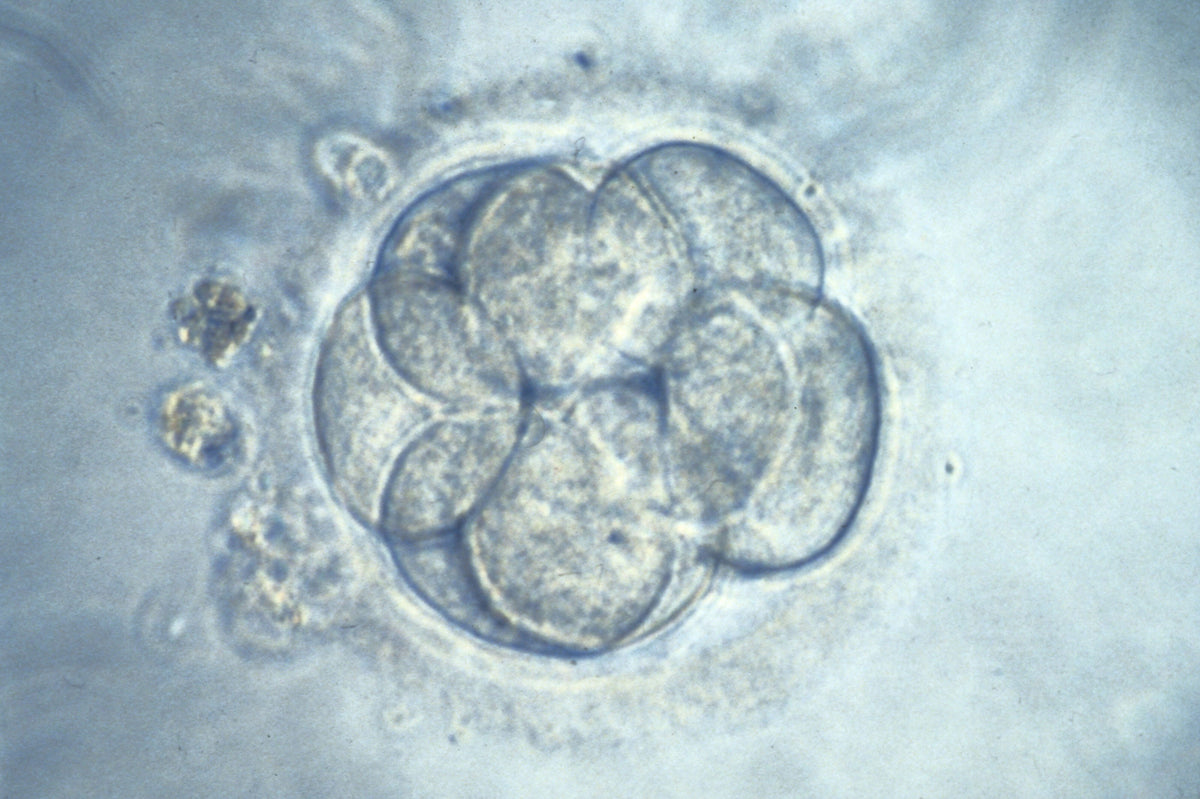
Eggs collected by Steptoe, fertilised by Edwards and cared for by Jean Purdy divided, again and again, into embryos of eight and sixteen cells.
The story
Fertilisation is only the beginning. To make a pregnancy possible, the fertilised egg has to grow into an embryo ready to go back to the mother.
In September 1970 the team reported exactly that. Their embryos divided to eight and sixteen cells, the stage at which an embryo could be returned to the womb.
This is the first of the great papers to carry Jean Purdy's name. She was a nurse from Cambridge who had joined Edwards two years earlier, and she would be part of every step that followed.
“Human oocytes have been taken from the mother before ovulation, fertilized in vitro and grown in vitro to the eight- or sixteen-celled stage in various media.”The paper's summary
The paper
Fertilization and Cleavage in vitro of Preovulator Human Oocytes
Robert Edwards, Patrick Steptoe, Jean Purdy
Nature 1970;227(5265):1307 to 1309. Published 26 September 1970. (“Preovulator” is spelled this way in the published title.) Read the paper.
How we know
Citation and summary from nature.com, PubMed and Crossref, read 6 October 2026. The full text was not re-read.
Collapsible tab
Collapsible tab
Image block
Use these image blocks to tell your story, promote your products or create a beautiful gallery.
Text block
Use these text blocks to promote seasonal sales, store events or to tell your brand's story.
Text block
Use these text blocks to promote seasonal sales, store events or to tell your brand's story.
Image block
Use these image blocks to tell your story, promote your products or create a beautiful gallery.
Testimonials
Use these testimonials to share what customers are saying about your products and your brand.
Customer name
Source
Use these testimonials to share what customers are saying about your products and your brand.
Customer name
Source
Use these testimonials to share what customers are saying about your products and your brand.
Customer name
Source
Image with text
Use these blocks to share your brand's story. You can focus on a particular collection, a product detail, or even embed a video.
Image with text
Use these blocks to share your brand's story. You can focus on a particular collection, a product detail, or even embed a video.

